
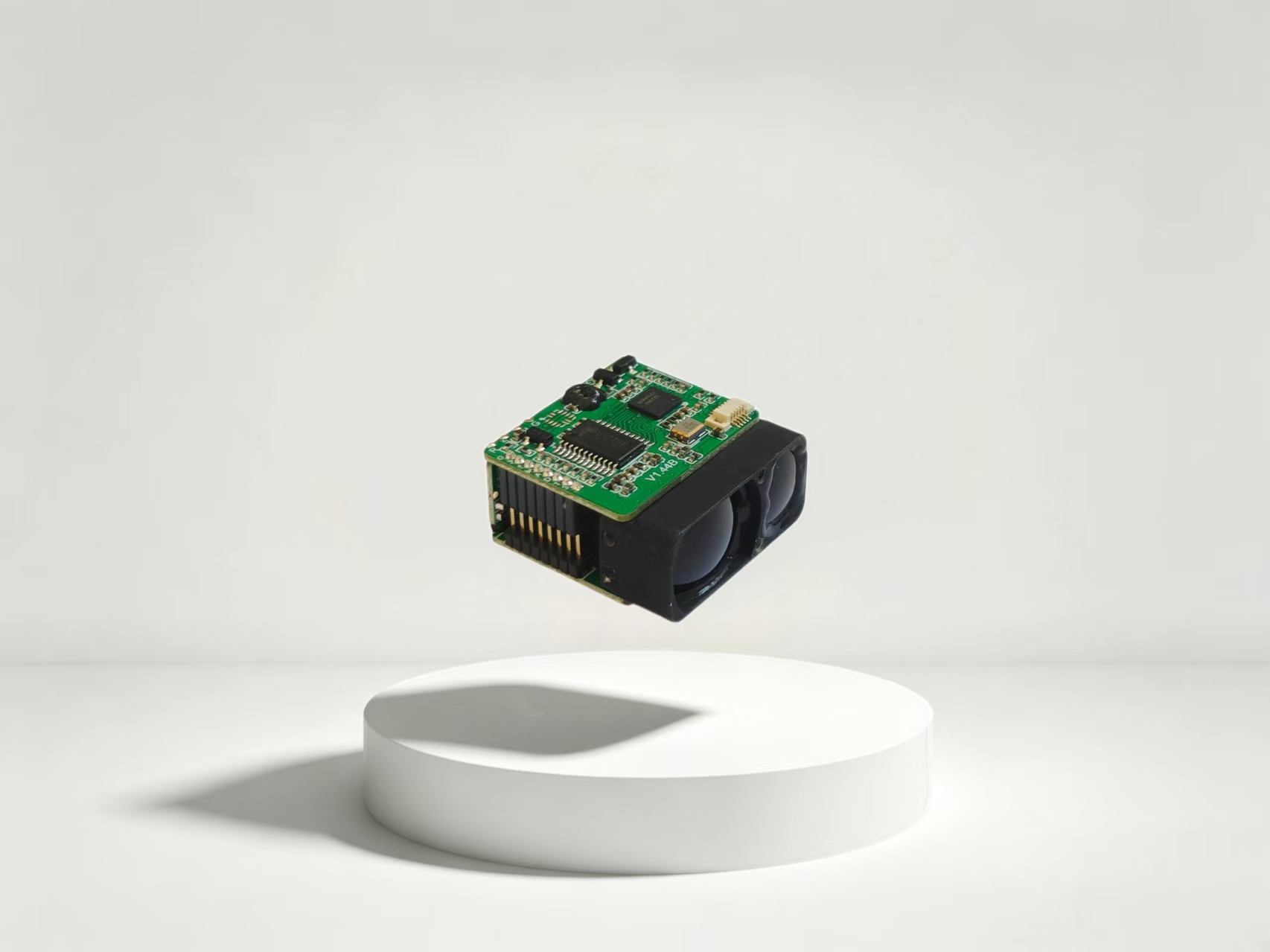

Tout d’abord, grâce à la technologie de télémétrie par laser à impulsions à semi-conducteur de 905 nm, le nouveau SFA1200BJ offre une télémétrie stable sur toute la plage de mesure, de 5 m à 1 200 m. Il allie une sécurité oculaire de classe 1, une conception ultra-légère et compacte, une fiabilité de niveau industriel et une faible consommation d’énergie de l’ordre du nanowatt. Il constitue ainsi une solution embarquée idéale pour les applications exigeantes de moyenne à longue portée, telles que la topographie aérienne, l’exploration géologique, les forces de l’ordre, les équipements de plein air et le relevé des stations de base de télécommunications.
I. Conception optomécanique intégrée : solution de télémétrie miniaturisée et hautement fiable
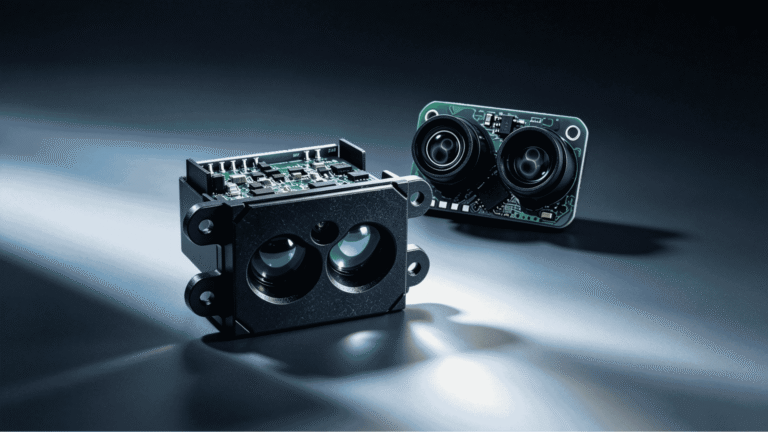
De plus, le SFA1200BJ intègre une conception opto-électro-mécanique hautement intégrée, associée à une photodétection haute sensibilité et à des algorithmes intelligents de traitement du signal. Il offre ainsi des performances de niveau industriel dans un format compact, ce qui lui confère des avantages évidents par rapport aux modules de télémétrie traditionnels dans les scénarios d'intégration embarquée :
- Pour commencer, Il offre une portée de 1 200 m, assurant une couverture stable sur des cibles de type 70% (bâtiments réfléchissants) et pouvant atteindre 1 500 m sur des cibles à haute réflectivité.
- Par ailleurs, Il émet une lumière invisible dans le proche infrarouge à 905 nm, est certifié « sans danger pour les yeux » (classe 1 selon la norme CEI 60825-1) et maintient une puissance laser moyenne de 7,63 mW, ce qui signifie qu’il n’y a aucune restriction d’utilisation dans les environnements civils ouverts.
- De plus, Il offre une protection IP67 contre la poussière et l'eau, garantissant ainsi un fonctionnement fiable à long terme sous la pluie, dans la poussière, en milieu humide et dans d'autres conditions extérieures difficiles.
- Par ailleurs, Il offre une excellente résistance aux chocs mécaniques : il supporte des chocs de 1 000 g/ms (10 fois par seconde le long de l'axe optique) et des vibrations à large bande de 2,5 g, ce qui le rend adapté aux applications aériennes et embarquées.
- Par ailleurs, Il fonctionne sur une large plage de températures – il reste stable entre -20 °C et +60 °C et peut être stocké entre -25 °C et +75 °C, ce qui lui permet de s'adapter à des conditions climatiques très variées.
- Il convient notamment de noter que, Il est conçu pour réduire au minimum les fausses alarmes grâce à un algorithme intelligent intégré de protection contre les interférences environnementales, qui permet d'atteindre un taux de détection ≥ 98% et un taux de fausses alarmes ≤ 1%, évitant ainsi les déclenchements intempestifs dans des environnements complexes.
- Par ailleurs, Il prend en charge des modes de mesure flexibles, offrant une mesure ponctuelle ou en continu avec des intervalles personnalisables pour répondre à divers besoins de test.
- Enfin, Elle permet un mode veille profonde de l'ordre du nanowatt – avec une consommation en veille aussi faible que 1 mW –, ce qui prolonge considérablement l'autonomie des appareils portables.
II. Spécifications techniques essentielles
Tout d'abord, le SFA1200BJ offre une portée maximale de 1 200 m (sur une cible de type bâtiment réfléchissant 70%, avec une visibilité ≥ 6 km) et une portée minimale de 5 m (sur un tableau blanc réfléchissant 90%). De plus, il offre une précision de mesure de ±0,7 m pour les distances ≤ 100 m, et de ±(0,7 + 0,004 × d) m pour les distances > 100 m. De plus, il offre une fréquence de mesure de 3 Hz pour la mesure en continu d’une même cible, et de 2 Hz lors du passage d’une cible à l’autre. Par ailleurs, il maintient un taux de détection de ≥ 98%, avec un taux de fausses alarmes de ≤ 1%.
Sur le plan de la conception physique, le module présente un format rectangulaire miniaturisé et intégré, avec des dimensions de 14,5 mm × 25 mm × 26 mm et un poids de 12 ± 0,5 g. Il s'intègre donc facilement dans une large gamme de dispositifs optoélectroniques compacts. De plus, son angle de divergence laser typique est ≤ 10 mrad, avec un champ de vision du récepteur de ≈ 8 mrad, ce qui garantit une grande précision de pointage.
En ce qui concerne la résistance aux conditions environnementales, le module fonctionne entre -20 °C et +60 °C et peut être stocké entre -25 °C et +75 °C. Son temps moyen entre pannes (MTBF) est ≥ 1 500 heures, ce qui garantit un fonctionnement stable à long terme.
En ce qui concerne les besoins en alimentation, la tension d'alimentation spécifiée est de 3,3 V CC ± 0,1 V. La consommation en veille est inférieure ou égale à 350 mW (mode « Power on low ») et inférieure ou égale à 1 mW (mode « Power on high », veille profonde). La puissance de fonctionnement est de ≤ 1,3 W à -20 °C, de ≤ 1,5 W à 25 °C et de ≤ 1,8 W à 70 °C.
Par ailleurs, le temps de réponse du système (typique) est le suivant : à courte portée ≤ 550 ms + 46 ms, et à longue portée ≤ 550 ms + 458 ms.
De plus, le module prend en charge la commutation entre les modes de mesure ponctuelle et continue, un mode d’étalonnage à diode laser allumée en permanence, un autotest à la mise sous tension et la signalisation des états anormaux. Pour la communication, nous l’équipons d’une interface série UART (TTL_3,3 V) standard, avec un débit en bauds par défaut de 115 200 bps, réglable entre 9 600 et 230 400 bps. De plus, nous fournissons un protocole de communication complet ainsi qu’un logiciel de test dédié pour PC, permettant un développement secondaire accessible à tous.
(Données basées sur des conditions standard : ligne de visée, visibilité ≥ 6 km, humidité relative ≤ 70%, réflectivité de la cible ≥ 0,7. Une réflectivité inférieure ou des conditions environnementales défavorables peuvent réduire la portée effective.)
III. Couverture complète des applications
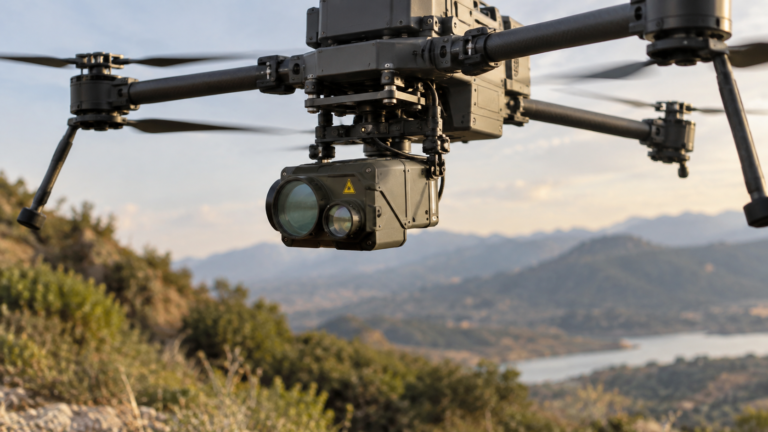
- Aérospatiale et drones : Tout d'abord, ce module est destiné aux drones de levé topographique, aux drones d'inspection et aux petits modèles réduits d'aéronefs. Sa portée de 1 200 m permet de couvrir de vastes zones opérationnelles, et sa conception légère (12 g) n'ajoute qu'une charge de vol minime.
- Levés géologiques et techniques : D'autre part, il est utilisé pour la cartographie topographique, les levés de chantier, l'exploration minière et l'inspection des canalisations. La haute précision des données qu'il fournit garantit la qualité des travaux d'ingénierie.
- Forces de l'ordre et secours d'urgence : Troisièmement, il facilite les enquêtes sur les scènes de crime, la mesure des distances, le repérage des lieux d'intervention et la collecte de preuves, ce qui permet d'intervenir rapidement dans des environnements de terrain complexes.
- Équipements de plein air et de sport : Quatrièmement, il s'intègre aux télémètres laser à longue portée, aux télescopes et aux équipements d'exploration en plein air, offrant ainsi une grande portabilité grâce à son poids léger et à une autonomie prolongée.
- Secteur des télécommunications et de l'énergie : De plus, il facilite le levé topographique des stations de base, l'inspection des lignes électriques et la mesure de la distance entre les pylônes. Sa précision à longue portée améliore l'efficacité opérationnelle.
- Sécurité et surveillance industrielles : Enfin, il prend en charge la surveillance du périmètre des campus, la protection des installations critiques et la localisation d'objets industriels, offrant ainsi une détection d'intrusion à longue portée stable et fiable.
IV. Consignes d'utilisation
Sécurité : Tout d'abord, ce produit est un laser de classe 1 sans danger pour les yeux. Nous vous recommandons toutefois d'éviter de regarder directement et de manière prolongée l'ouverture du laser afin de prévenir toute fatigue oculaire potentielle. Par ailleurs, le mode d'étalonnage du spot est réservé à l'usage des développeurs ; ne dirigez pas le laser vers les yeux d'une personne lorsque ce mode est activé.
Protection contre les décharges électrostatiques : De plus, il est indispensable de respecter les mesures de précaution nécessaires contre les décharges électrostatiques. Ne touchez aucun composant électronique sans avoir pris les mesures de protection adéquates. Ne branchez ni ne débranchez jamais de câbles lorsque le module est sous tension. Veillez également à respecter la polarité d'alimentation et à ce que la tension reste comprise entre 3,3 V ± 0,1 V ; le non-respect de ces consignes peut entraîner des dommages irréversibles.
Entretien des vitres optiques : Veillez également à ce que la lentille optique reste propre. Utilisez un souffleur pour éliminer les particules de poussière. Pour les traces de doigts, essuyez délicatement à l’aide d’un coton-tige imbibé d’une petite quantité de mélange alcool-éther, puis nettoyez avec un chiffon pour lentilles. Ne touchez pas directement la surface optique avec les doigts. Pour la fenêtre optique, nous recommandons d’utiliser du verre optique Chengdu Guangming H-K9L ou de la silice fondue, recouvert d’un revêtement antireflet de 855 nm à 955 nm (transmittance ≥ 99,51 TP3T). L'épaisseur de la fenêtre doit être comprise entre 2 et 4 mm, avec un espace d'air inférieur à 0,5 mm par rapport au télémètre.
Précautions environnementales : Par ailleurs, nous vous recommandons d'éviter toute utilisation prolongée dans des environnements caractérisés par des températures élevées, une forte humidité, un environnement hautement corrosif ou de fortes interférences électromagnétiques. Veillez également à protéger le module contre les variations brusques de température et les chocs mécaniques importants. Pour garantir la précision des mesures, veillez à ce que le faisceau laser soit autant que possible perpendiculaire à la surface cible. Notez également que des conditions météorologiques défavorables, telles que la pluie, le brouillard ou la brume, réduiront la portée effective.
Modification et câblage : Par ailleurs, ne démontez pas, ne modifiez pas et n’altérez pas le module, car cela entraînerait l’annulation de la garantie. Utilisez le câble de communication à 6 broches d’origine fourni. Si vous utilisez un câble personnalisé, vérifiez que l’affectation des broches est correcte afin d’éviter une inversion des broches TX/RX, ce qui pourrait provoquer des erreurs de communication.
Démarrage et gestion de l'alimentation : Enfin, prévoyez environ 550 ms après la mise sous tension pour l'initialisation du système. Mettez la broche d'activation à l'état bas avant d'envoyer des commandes de télémétrie. Pour sortir du mode veille profonde, mettez la broche d'activation à l'état haut, puis, une fois les mesures terminées, remettez-la à l'état haut pour repasser en mode basse consommation.
Conclusion
En conclusion, le SFA1200BJ allie une portée de 1 200 m, un poids ultra-léger de 12 g, une protection totale IP67, une durabilité de niveau industriel et une faible consommation d’énergie de l’ordre du nanowatt. Il constitue donc un composant de télémétrie haute performance idéal pour les systèmes embarqués compacts et les applications de mesure en extérieur à moyenne et longue portée. De la topographie aérienne et de la cartographie géologique aux forces de l'ordre et aux équipements de plein air, le SFA1200BJ permet aux systèmes de détection intelligents d'atteindre des distances plus lointaines, de fonctionner de manière plus stable et d'offrir une plus grande fiabilité.
 English
  العربية
  Français