
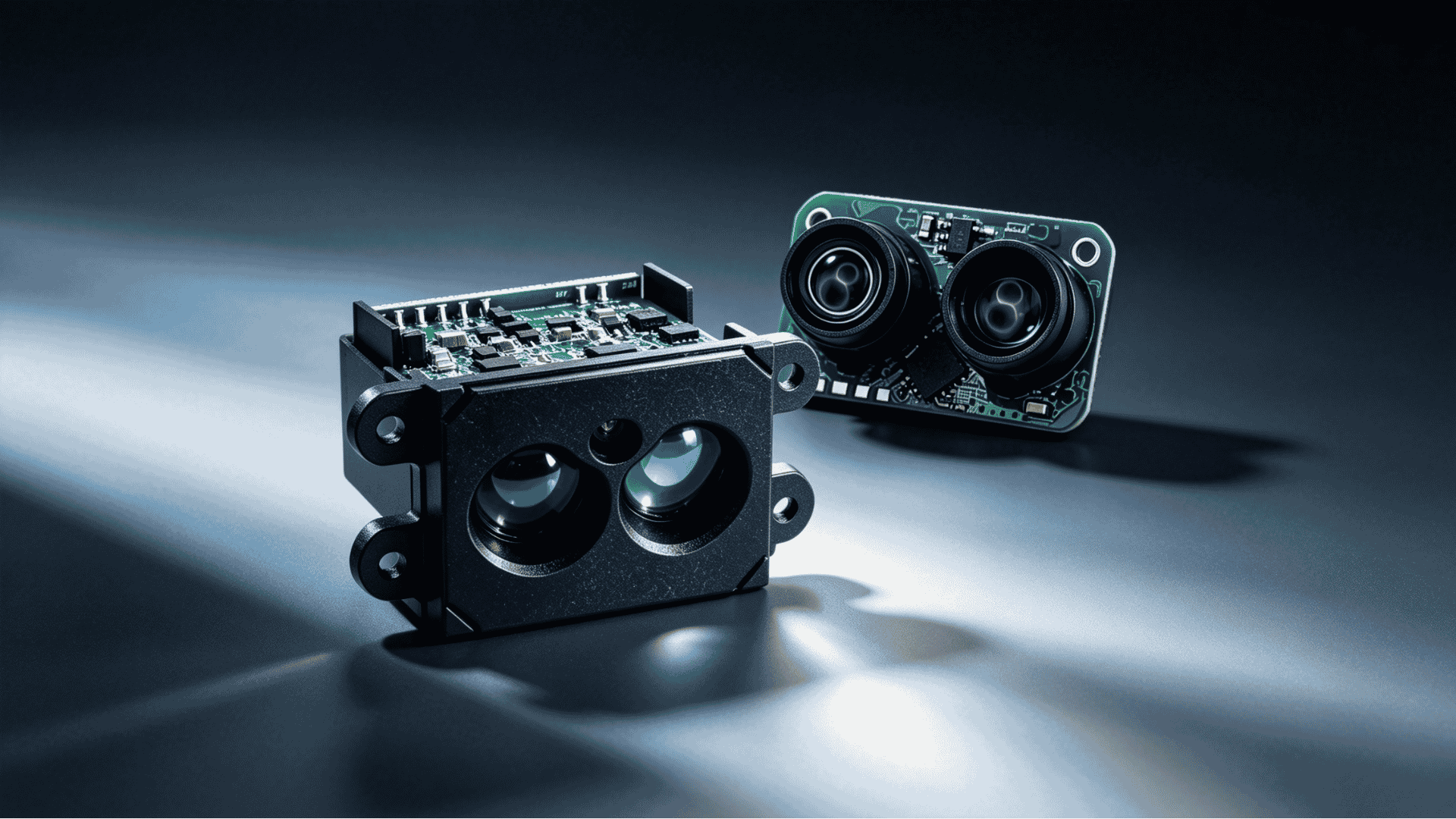

Pour commencer, among the SunFlaser SFX series 905nm pulsed TOF miniature laser ranging modules, the SFX50A and SFX50B both serve as 50m‑class short‑range products. Both employ the DTOF ranging principle and feature small size and high reliability. Cependant, the two products differentiate their designs in power supply system, structural form, and functional configuration, corresponding to integration needs in different fields. Par conséquent, this article compares them from three dimensions – core parameters, functional characteristics, and applicable scenarios – for selection reference.
I. Core Positioning Differences
Avant toute chose, the two products have different design starting points and correspond to completely different integration scenarios. In other words, there is no distinction of superior or inferior performance; they merely adapt to different engineering constraints.
SFX50A: Ultra‑miniature low‑power positioning, aimed at embedded and small mobile device scenarios. Plus précisément, it minimizes volume and power consumption as much as possible, making it suitable for terminal devices with highly constrained space and power supply.
SFX50B: Industrial‑grade wide‑voltage positioning, aimed at industrial site monitoring and medium‑sized mobile device scenarios. De plus, it enhances environmental adaptability and installation/commissioning convenience, adapting to the engineering standards and wiring requirements of industrial scenarios.
II. Core Parameter and Functional Differences
1. Power Supply and Consumption: Low‑Voltage Micro‑Power vs. Wide‑Voltage Industrial‑Grade
The SFX50A uses a 3.3–5V low‑voltage supply with an average power consumption of only 0.2W. Par conséquent, it suits battery‑powered small mobile devices and offers clear advantages in power‑sensitive scenarios.
The SFX50B uses a 9–36V wide‑range DC supply, allowing direct connection to industrial site power systems. Par conséquent, it withstands power supply fluctuations and adapts to diverse power conditions in industrial sites.
2. Structure and Installation: Micro Embedded vs. Industrial Terminal Wiring
The SFX50A has overall dimensions of only 18.7×11.8×13.3mm and weighs 1.3g. Thus, it serves as an ultra‑miniature ranging module, supplied with a standard 4‑pin 1.0mm connector and 10cm short wires, suitable for embedded installation inside equipment with extremely limited space.
The SFX50B measures 38×20×30mm and weighs 15±2g, with higher structural strength. Par ailleurs, it comes standard with a 5‑pin 1.25mm industrial connector and 50cm tinned loose wires, adapting to standard wiring and installation methods for industrial equipment.
3. Optics and Ranging Performance: Ultra‑Short Blind Zone vs. Strong Ambient Light Resistance + Coaxial Aiming Light
Range and blind zone: The SFX50A has a ranging blind zone as low as 0.05m, offering stronger close‑range edge detection capability, with a 50m range at 90% reflectivity. En revanche, the SFX50B achieves a range of up to 45m under 100KLux ambient light, with better ambient light resistance, suitable for outdoor strong‑light scenarios.
Repeatability: The SFX50A has a repeatability of ±30mm and accuracy of ±5cm within 5m. Par ailleurs, the SFX50B has a repeatability of ±5cm and higher measurement accuracy.
Measurement frequency: The SFX50A defaults to 500Hz. De plus, the SFX50B defaults to 1kHz and supports adjustable 20Hz–10kHz, suitable for control scenarios requiring higher response speeds.
Coaxial aiming light: The SFX50A has no aiming light configuration. By contrast, the SFX50B has a built‑in 650nm visible red aiming light path, which can be independently switched via serial port. During installation and commissioning, it visually indicates the optical path position for quick optical axis alignment.
4. Interface and Configuration: Dual‑Interface Flexibility vs. Industrial‑Grade Standard Interface
The SFX50A supports both UART TTL and IIC communication interfaces, adapting to different types of small main control units with higher integration flexibility.
Similarly, the SFX50B uses a standard UART interface with a complete industrial‑grade command set, supporting baud rate modification, frequency configuration, and ranging start/stop functions, adapting to the standard communication logic of industrial control systems.
III. Core Parameter Comparison Table
We take the following parameters from the corresponding model product specifications and note the test conditions. Actual performance may vary depending on target reflection characteristics, ambient temperature, and lighting conditions.
| Paramètres | SFX50A | SFX50B |
|---|---|---|
| Effective range | 0.05–50m (90% reflectivity); 0.05–20m (10% reflectivity) | 0.05–50m (90% reflectivity); 0.05–20m (10% reflectivity) |
| Ranging blind zone | 0.05m | 0.05m |
| Repeatability | ±30mm | ±5cm |
| Measurement accuracy | ±5cm (<5m); 1% (≥5m) | ±5cm (<5m); 1% (≥5m) |
| Measurement frequency | Default 500Hz | Default 1kHz, adjustable 20Hz–10kHz |
| Main laser | 905nm, Class 1 | 905nm, Class 1 |
| Aiming light | None | 650nm red light, Class 2, independently switchable |
| Champ de vision | 1.9° | Approx. 4mrad |
| Ambient light resistance | 10m @ 60KLux | 45m @ 100KLux |
| Operating voltage | 3.3–5VDC | 9–36VDC |
| Average power consumption | 0.2W (at 5V) | 0.8W (at 24V) |
| Interface de communication | UART TTL + IIC | UART |
| Dimensions | 18.7×11.8×13.3mm | 38×20×30mm |
| Poids | 1.3g | 15±2g |
| Electrical connection | 4‑pin 1.0mm connector, 10cm loose wires | 5‑pin 1.25mm connector, 50cm loose wires |
| Température de fonctionnement | De -20°C à +60°C | -20°C to +60°C (aiming light off) |
IV. Scenario Selection Recommendations
We recommend the SFX50A for the following scenarios:
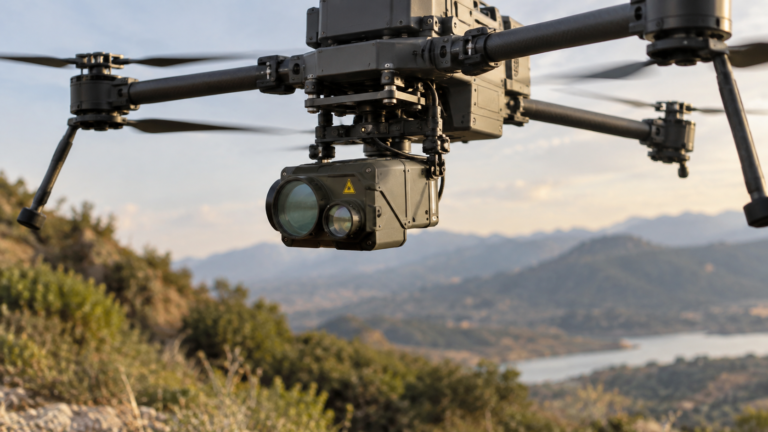
- Altitude hold for micro UAVs and obstacle avoidance for small UAVs, with strict requirements on weight and power consumption.
- Obstacle avoidance for small AGVs and service robots, where internal installation space is limited.
- Embedded small monitoring devices and micro sensor modules requiring an IIC communication interface.
- Battery‑powered terminals with high power sensitivity, requiring extremely low standby and operating power consumption.
We recommend the SFX50B for the following scenarios:
- Positioning for industrial overhead cranes and lifting equipment, and distance control for carriage coupling.
- Industrial security and perimeter monitoring, deployed in outdoor strong‑light environments.
- Inspection robots and medium‑sized mobile devices requiring wide‑voltage power supply and high‑frequency ranging.
- High requirements for on‑site installation and commissioning convenience, requiring a coaxial aiming light to assist optical axis alignment.
Conclusion
En conclusion, both products represent mature, mass‑produced miniature ranging solutions from SunFlaser, corresponding to different integration requirements and scenario positioning. Par conséquent, you can comprehensively determine actual selection based on equipment power supply conditions, installation space, functional requirements, and target scenarios.
Par ailleurs, all SunFlaser ranging modules support custom form factors and output protocol customization, and we can cooperate with customers to complete targeted adaptation.

 English
  العربية
  Français