

1. The Relationship Between Optoelectronic Payload and Optoelectronic Pod
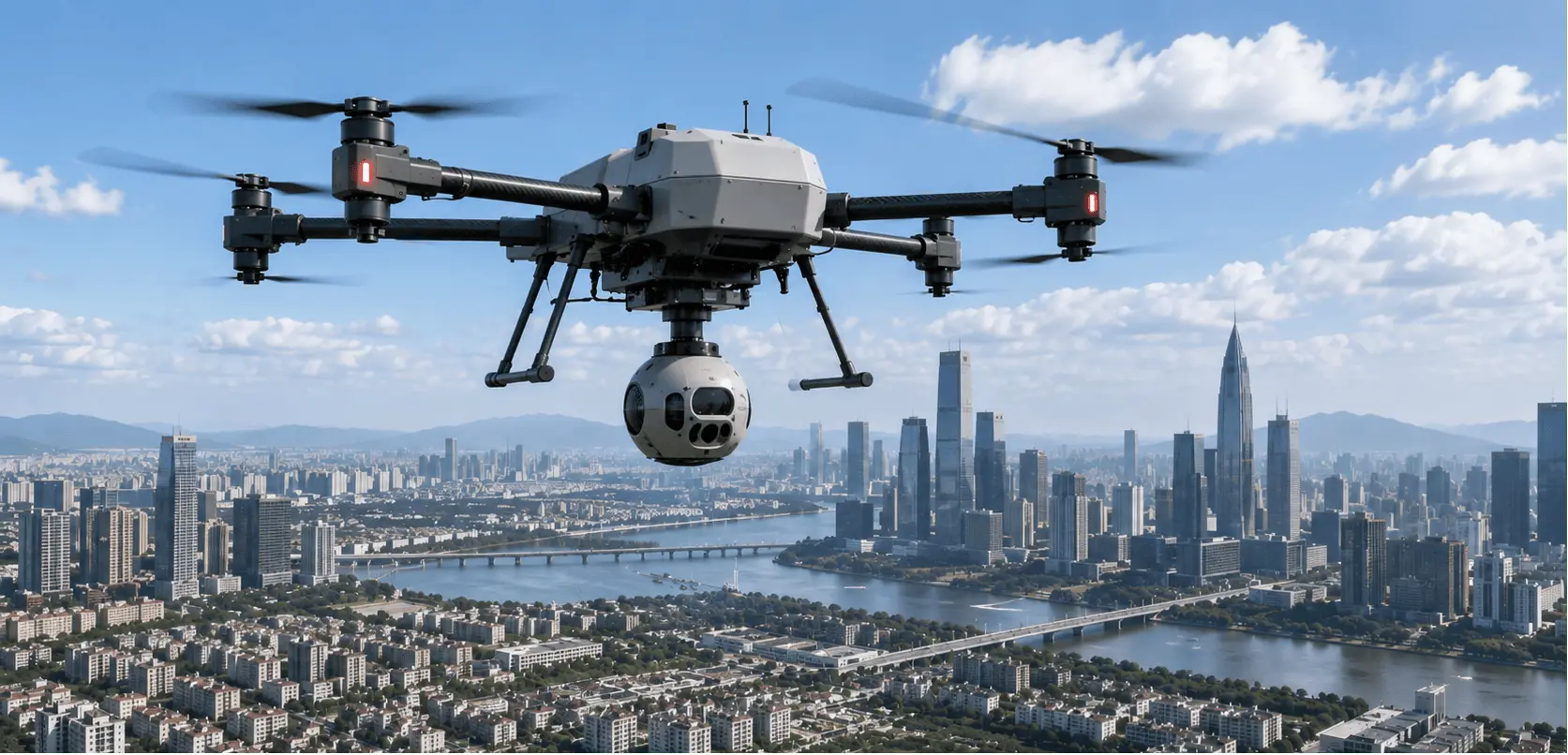
Industry discussions often use “optoelectronic payload” and “optoelectronic pod” interchangeably. However, according to aviation optoelectronic industry terminology (GB/T 43369‑2023), these two terms describe a whole‑to‑subset relationship.
1.1 Optoelectronic Payload (Optoelectronic Mission Payload)
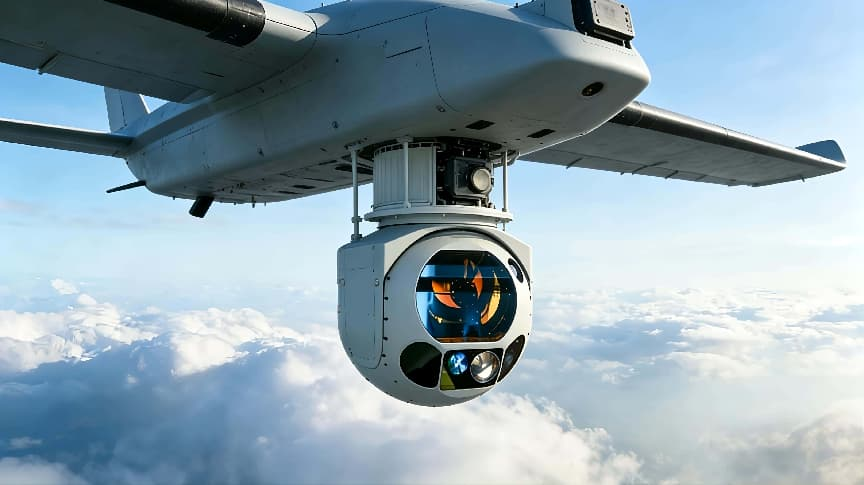
This term covers a broad category. It generally refers to all optoelectronic devices mounted on mobile platforms, such as UAVs and unmanned ground vehicles. These devices rely on optical and electronic technologies for imaging, ranging, and target detection. The payload comes in three physical forms: integrated pods, separate functional modules, and simple camera units. Together, they cover scenarios ranging from consumer‑grade to industrial‑grade.
1.2 Optoelectronic Pod
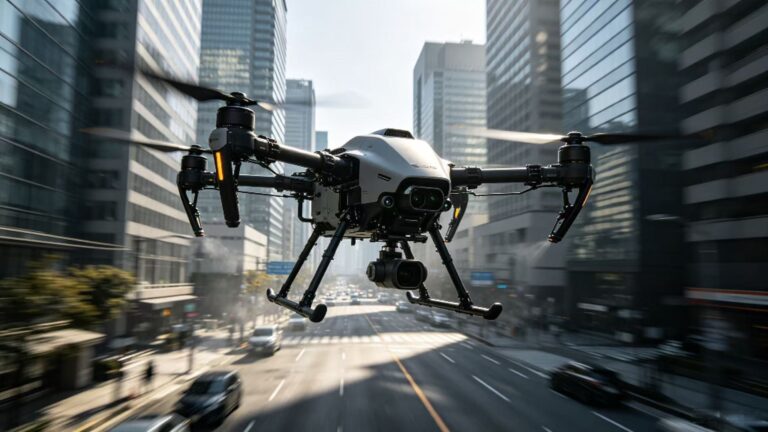
The optoelectronic pod is an integrated, all‑in‑one optoelectronic payload. It also represents the mainstream configuration for industrial UAVs. The pod integrates a stabilised gimbal, multiple sensors, and a data processing unit inside a sealed enclosure. This design effectively counters vibration and attitude deviations during flight. Consequently, its technical complexity and overall performance far exceed those of separate modules.
In daily colloquial usage, people often simplify these terms. Nevertheless, in formal contexts—such as project tenders, technical proposals, and equipment procurement—you must strictly distinguish between their forms and functions.
2. Core Architecture: Three Major Sensors + Auxiliary Systems
2.1 Visible‑Light Imaging Unit
The visible‑light camera serves as the core sensor for daytime operations. Mainstream industrial configurations equip a 20‑ to 30‑times optical zoom lens paired with high‑definition imaging chips.
The advantages include clear daytime imagery and strong target detail recognition.
As a result, the unit enables long‑distance detection of line defects, equipment surface faults, and other visible issues. It is the basic setup for daytime inspection and routine surveillance.
2.2 Uncooled Infrared Thermal Imaging Unit
This unit operates in the 8‑14 μm infrared atmospheric window. It is the key enabler for 24/7 all‑weather operation. The critical parameter is NETD (Noise Equivalent Temperature Difference). Mainstream industrial equipment achieves NETD ≤ 50 mK. A smaller NETD value means higher thermal sensitivity, allowing the detector to distinguish smaller temperature differences. Moreover, infrared can penetrate darkness, rain, fog, and smoke. Therefore, it can precisely detect fire sources, overheating equipment, and concealed targets. It is widely used in fire prevention, night security, and thermal defect inspection of power equipment. Currently, uncooled infrared dominates civilian industrial applications, offering instant start‑up, low power consumption, and high reliability.
2.3 Laser Rangefinding Unit
This unit provides precise distance coordinates for targets, making it a core component for industrial positioning. The industry currently uses three main wavelengths, and they differ significantly in safety and performance.
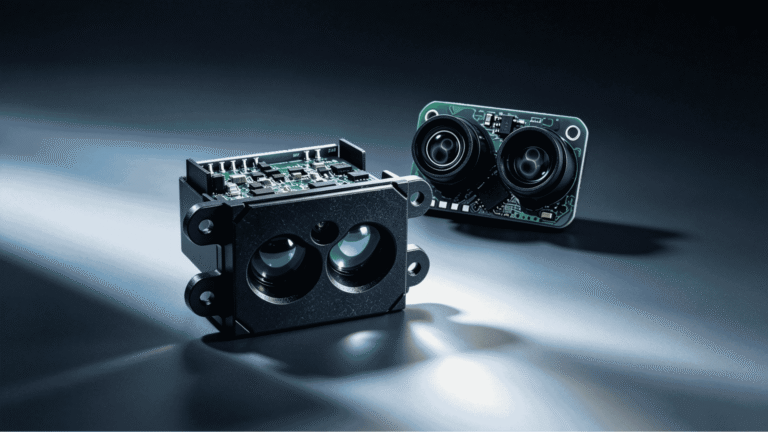
- 1535 nm Er:Glass laser – This laser complies with GB 7247.1‑2012 (equivalent to IEC 60825‑1) Class 1 eye‑safe standard. Under normal use, direct beam exposure does not damage the human retina. Therefore, it is the preferred choice for crowded environments and routine inspection scenarios. Typical specifications include a ranging range of 50‑5000 m, full‑range accuracy ≤ ±1 m, and a hit rate ≥ 98 %.
- 905 nm / 1064 nm lasers – These lasers are mostly rated Class 3R or Class 4, which can cause eye damage. They are only suitable for enclosed, unmanned, or special applications. In civilian low‑altitude sectors, they are gradually being replaced by 1535 nm lasers.
2.4 High‑Precision Stabilised Gimbal and Control System
During flight, UAVs experience vibration and attitude changes. The gimbal is essential for ensuring data stability. Industrial‑grade optoelectronic pods come in two‑axis and three‑axis configurations. Their stabilisation accuracy reaches ±0.02° to ±0.03°. The azimuth supports 360° continuous rotation, while the pitch covers ‑30° to +120°. These features ensure stable images and ranging data with minimal jitter.
Additionally, the pod incorporates a main control unit. This unit supports multiple data output protocols, including RTSP, UART, and RS422. It is also compatible with mainstream ground control stations and control systems.
3. Core Capabilities: Tri‑Sensor Fusion for All‑Weather “Smart Eyes”
What Tri‑Sensor Fusion Really Means
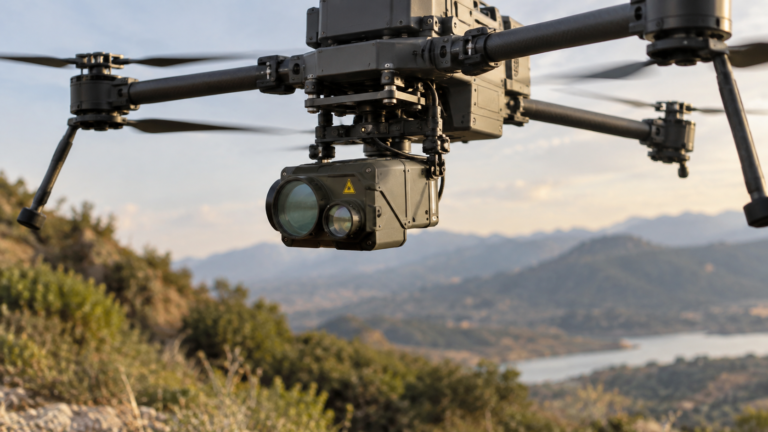
Tri‑sensor fusion is not merely a hardware stack. It is a technological integration that combines multi‑sensor temporal‑spatial synchronisation and data linkage. This integration endows the optoelectronic payload with four core capabilities:
All‑Weather Operation – The system relies on visible light for high‑definition observation during daytime. At night or in adverse weather, it switches to infrared imaging. As a result, it overcomes limitations of light and weather.
Precise Positioning – It combines infrared and visible light for target acquisition, and uses laser rangefinding for accurate distance coordinates. This integration achieves integrated recognition and positioning.
AI‑Powered Intelligent Tracking – Mainstream industrial devices support multi‑target recognition and tracking. They can identify personnel, vehicles, and other objects simultaneously. Moreover, they can maintain tracking even after brief occlusion (approx. 2 seconds). This capability suits security and search‑and‑rescue scenarios.
Environmental Adaptability – Standard industrial‑grade products operate in temperatures from ‑10 °C to +55 °C (storage: ‑20 °C to +60 °C). They have an IP54 protection rating. They have also passed MIL‑STD‑810G and GJB series vibration and shock tests. Consequently, they adapt well to harsh outdoor environments, including extreme temperatures and sandstorms.
4. Main Application Scenarios
Leveraging its robust hardware capabilities, the optoelectronic payload has deeply penetrated various segments of the low‑altitude economy. Below are some typical applications:
Power Line Inspection – Visible light detects broken strands and insulator damage. Infrared identifies overheating risks. Laser precisely marks towers and fault points. Together, these enable comprehensive line inspection.
Forest Fire Prevention – Infrared remotely detects open flames and smouldering fires. It can distinguish normal vegetation from high‑temperature sources. Laser marks fire coordinates to aid firefighting route planning.
Emergency Search and Rescue – The system switches between day and night modes. It locates trapped persons in complex environments such as mountains, ruins, and at night.
Border / Facility Security – It provides 24/7 surveillance. It automatically identifies and continuously tracks intruders, thereby improving security efficiency.
5. Industry Summary and Cooperation
The Growing Low‑Altitude Economy
As a key emerging industry under national development, the low‑altitude economy continues to expand the application scenarios for industrial UAVs. As the core sensing equipment, optoelectronic payload technology is evolving towards miniaturisation, higher sensitivity, intelligence, and enhanced safety.
Important Selection Advice
There is a significant performance gap between simple modules and industrial‑grade devices. When selecting equipment, do not only consider price. It is essential to match parameters, safety levels, and environmental adaptability to your specific scenarios.
About SunFlaser
SunFlaser has been deeply engaged in the laser, infrared, and optoelectronic systems field for many years. Leveraging vertically integrated R&D and manufacturing capabilities, we offer self‑developed 1535 nm laser ranging modules, uncooled infrared modules, and full‑series optoelectronic pods. We hold nearly a thousand patents. Our products are certified under ISO 9001, FCC, FDA, CE, and meet both military and civilian environmental standards.
Customisation and Support
We provide standard optoelectronic equipment as well as full OEM/ODM customisation services. Our products adapt to UAV, vehicle‑mounted, handheld, and other platforms. If you have needs regarding optoelectronic payload selection, solution customisation, or technical consultation, please feel free to contact us privately for detailed product brochures and test reports.
 English
  العربية
  Français