
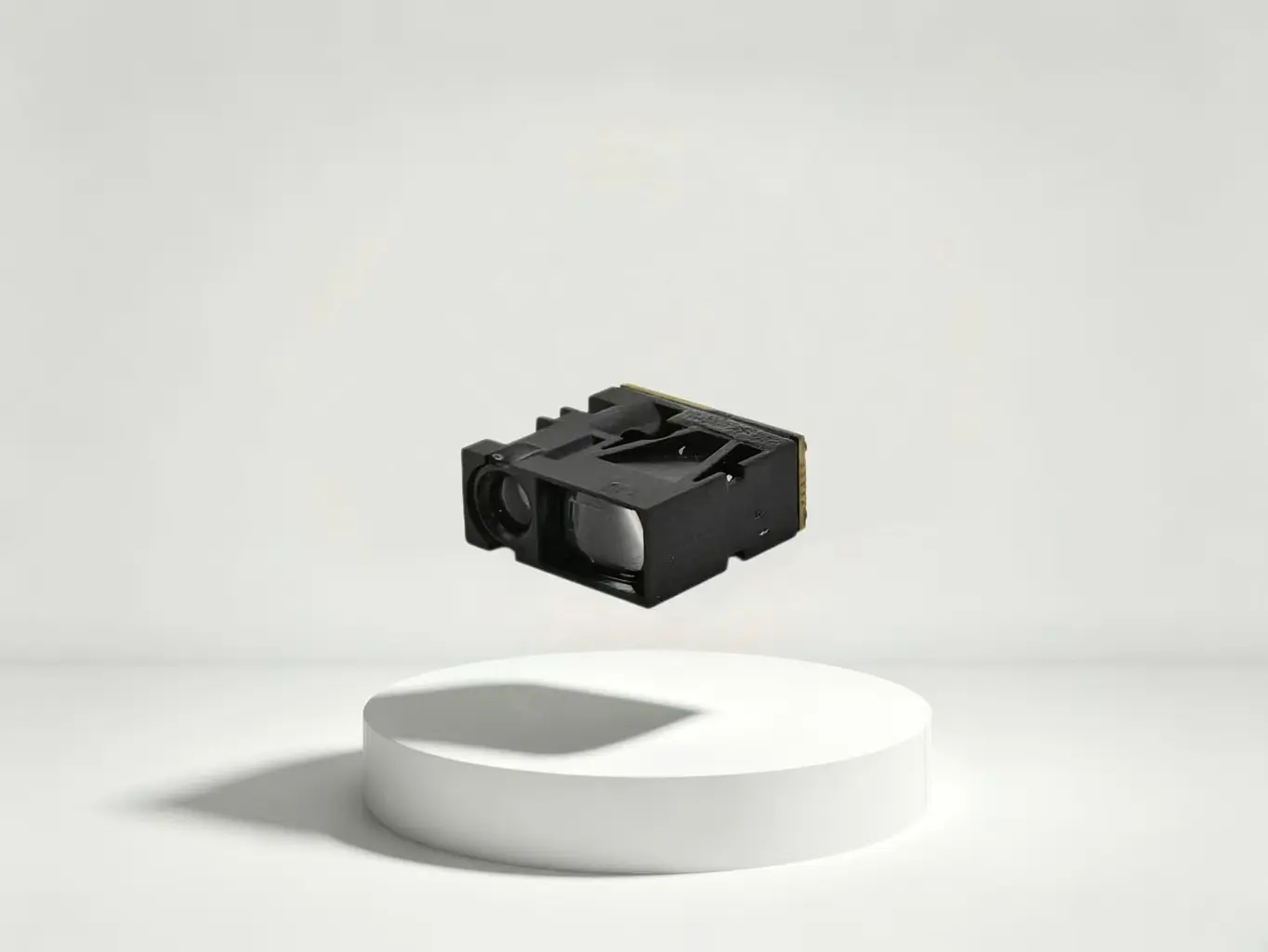

Tout d’abord, le SFA60A utilise une lumière rouge visible de 650 nm et la technologie de télémétrie par déphasage. Il offre ainsi une plage de mesure stable allant de 0,03 m à 60 m. De plus, il allie une sécurité oculaire de classe II, un design ultra-compact et léger, une haute précision de l'ordre du millimètre et une faible consommation d'énergie pour une autonomie prolongée de la batterie. Il constitue ainsi une solution professionnelle pour l'évitement d'obstacles par les robots, l'inspection dans le domaine de l'automatisation industrielle, les applications domotiques, les appareils de mesure portables et d'autres scénarios nécessitant une haute précision à courte portée.
I. Technologie de déphasage : le choix privilégié pour la télémétrie de haute précision à courte portée
Tout d'abord, le SFA60A s'appuie sur le principe éprouvé de la télémétrie laser à déphasage, intégré à une conception opto-mécano-électronique compacte. Il offre ainsi des avantages évidents par rapport aux modules TOF traditionnels dans les applications de mesure à courte portée :
- Avant toute chose, Il offre une haute précision de l'ordre du millimètre : une résolution de 1 mm et une sortie stable sur toute la plage, avec une précision allant jusqu'à ±(2 mm + D × 1/10 000).
- Par ailleurs, Il émet un faisceau de visée rouge visible de 650 nm, produisant un point clairement visible qui ne nécessite aucun étalonnage supplémentaire, offrant ainsi la simplicité d’une utilisation « pointer-mesurer ».
- De plus, Il garantit une sécurité oculaire de classe II – avec une puissance laser inférieure à 1 mW, conformément à la norme CEI 60825-1, ce qui le rend sûr pour une utilisation quotidienne.
- Par ailleurs, Il est doté d'une conception sans zone morte, avec une portée minimale de 0,03 m, ce qui permet d'obtenir des mesures précises même contre un mur.
- Enfin, Il prend en charge la mise en réseau multi-modules, pouvant accueillir jusqu’à 8 modules par segment de réseau, et jusqu’à 128 modules fonctionnant de manière collaborative sur plusieurs segments.
II. Spécifications techniques essentielles
Tout d’abord, le SFA60A offre une portée de 60 m (pour une réflectivité de 100% et une lumière ambiante de 1 kLux) et une distance minimale de 0,03 m. De plus, il offre une précision de mesure de ±(2 mm + D × 1/10 000) pour une réflectivité comprise entre 201 TP3T et 1 001 TP3T. Il offre également une résolution de distance de 1 mm, avec un taux de détection ≥ 981 TP3T.
Sur le plan de la conception physique, le module présente des dimensions compactes de 16,5 mm × 17 mm × 7 mm (L × l × H) et ne pèse que 2 g ± 0,5 g ; il est donc plus léger qu’une pièce de 1 jiao. Sa conception ultraplate permet une intégration aisée dans n'importe quel appareil miniature.
En ce qui concerne l'adaptabilité environnementale, le module fonctionne entre -10 °C et +50 °C et peut être stocké entre -25 °C et +60 °C. De plus, il répond aux exigences de protection électrostatique de niveau industriel et se caractérise par une conception compacte et robuste.
En ce qui concerne l'alimentation, nous avons conçu ce module pour une tension de 3,5 à 4,2 V CC (4,0 V recommandés). La consommation en veille est inférieure à 60 mW et la consommation en fonctionnement est inférieure à 320 mW ; cette faible consommation permet donc de prolonger l'autonomie des appareils portables.
De plus, le module prend en charge la commutation entre les modes de mesure ponctuelle et continue, les adresses de module personnalisables, l'étalonnage du décalage de mesure, la commande indépendante d'activation/désactivation du laser et l'interrogation en temps réel de l'état complet. Côté communication, nous l'avons équipé d'une interface série UART standard (TTL_3,3 V) et avons activé la détection automatique de la vitesse de transmission à 9 600/19 200/38 400/115 200 bps, ce qui facilite le développement d'applications secondaires.
(Données basées sur des conditions standard : ligne de visée, visibilité ≥ 20 km, humidité relative ≤ 80%, réflectivité de la cible ≥ 0,3. Une réflectivité plus faible ou des distances plus longues peuvent réduire la fréquence des mesures.)
III. Couverture complète des applications
- Évitement d'obstacles et navigation des robots : Tout d'abord, ce module est destiné aux robots de service, aux chariots AGV et aux aspirateurs robots. Sa précision au millimètre près permet d'éviter les collisions, et sa conception légère n'ajoute qu'une charge minime.
- Inspection dans le domaine de l'automatisation industrielle : D'autre part, il prend en charge le contrôle dimensionnel sur les chaînes de production, le positionnement d'objets et la mesure de niveau, offrant ainsi des performances stables et fiables qui améliorent l'efficacité de la production.
- Capteurs pour la maison connectée : Troisièmement, il permet l'utilisation de serrures intelligentes, de détecteurs de présence et de commandes de rideaux, offrant ainsi un déclenchement précis et une réponse rapide.
- Appareils de mesure portables : Quatrièmement, il s'intègre aux télémètres portables et aux mètres à ruban laser, et dispose d'un faisceau de visée rouge visible qui facilite son utilisation.
- Gamme de produits de sécurité et de surveillance : De plus, il facilite la sécurité périmétrique, la détection des intrusions et la mise au point automatique des caméras, grâce à des alarmes déclenchées avec précision.
- Surveillance du niveau de liquide/liquide : De plus, il permet de surveiller en temps réel les niveaux des réservoirs d'eau et des bacs à matériaux, tout en garantissant une faible consommation d'énergie pour une longue autonomie de la batterie.
- Intégration de petits dispositifs optoélectroniques : Enfin, il convient parfaitement aux jouets connectés, aux appareils portables et aux outils pédagogiques, grâce à sa taille compacte qui facilite son intégration.
IV. Consignes d'utilisation
Sécurité : Tout d’abord, ce produit est un laser de classe II sans danger pour les yeux, d’une puissance inférieure à 1 mW. Nous vous recommandons toutefois d’éviter de regarder directement l’ouverture du laser afin de prévenir toute fatigue oculaire potentielle. De plus, ne dirigez pas le laser vers des cibles hautement réfléchissantes (verre, murs blancs, métal poli) situées à moins de 15 m, car des signaux de retour excessifs pourraient endommager le détecteur APD.
Protection contre les décharges électrostatiques : Par ailleurs, il est indispensable de respecter les mesures de précaution nécessaires contre les décharges électrostatiques. Ne touchez aucun composant électronique sans avoir pris les mesures de protection adéquates. Ne branchez ni ne débranchez jamais de câbles lorsque le module est sous tension. Veillez également à respecter la polarité d'alimentation ; le non-respect de cette consigne peut entraîner des dommages irréparables.
Entretien des vitres optiques : Veillez également à ce que la lentille optique reste propre. Utilisez un souffleur pour éliminer les particules de poussière. Pour les traces de doigts, essuyez délicatement à l'aide d'un coton-tige imbibé d'une petite quantité de mélange alcool-éther, puis nettoyez avec un chiffon pour lentilles. Ne touchez pas directement la surface optique avec les doigts.
Précautions environnementales : De plus, évitez toute utilisation prolongée dans des environnements où règnent des températures élevées, de l'humidité, de la pluie, de la neige ou de la poussière. Protégez le module contre les changements brusques de température et les chocs mécaniques violents.
Modification et câblage : Par ailleurs, ne démontez pas, ne modifiez pas et n'altérez pas le module, car cela entraînerait l'annulation de la garantie. Utilisez le câble FPC fourni. Si vous utilisez un câble personnalisé, vérifiez que l'affectation des broches est correcte afin d'éviter une inversion des broches TX/RX, ce qui pourrait provoquer des erreurs de communication.
Start-up et communication : Enfin, prévoyez un délai de 100 ms après la mise sous tension pour l'initialisation du système. Mettez la broche PWREN à l'état haut avant d'envoyer des commandes. Pour les modules prenant en charge la détection automatique de la vitesse de transmission, envoyez l'octet de handshake 0x55 dans les 2,5 secondes suivant la mise sous tension afin de finaliser la configuration de la vitesse de transmission.
Conclusion
En conclusion, le SFA60A allie une précision de décalage de phase de l’ordre du millimètre, une conception ultra-légère de 2 g, une zone morte nulle de 3 cm et une faible consommation d’énergie pour une autonomie prolongée de la batterie. Il constitue donc un composant de télémétrie haute performance idéal pour un large éventail d’applications de mesure de haute précision à courte portée et d’intégration embarquée. De la robotique à l’automatisation industrielle en passant par les applications domotiques, le SFA60A permet aux systèmes de détection intelligents d’atteindre une plus grande précision, des dimensions plus compactes et une meilleure efficacité énergétique.

 English
  العربية
  Français