



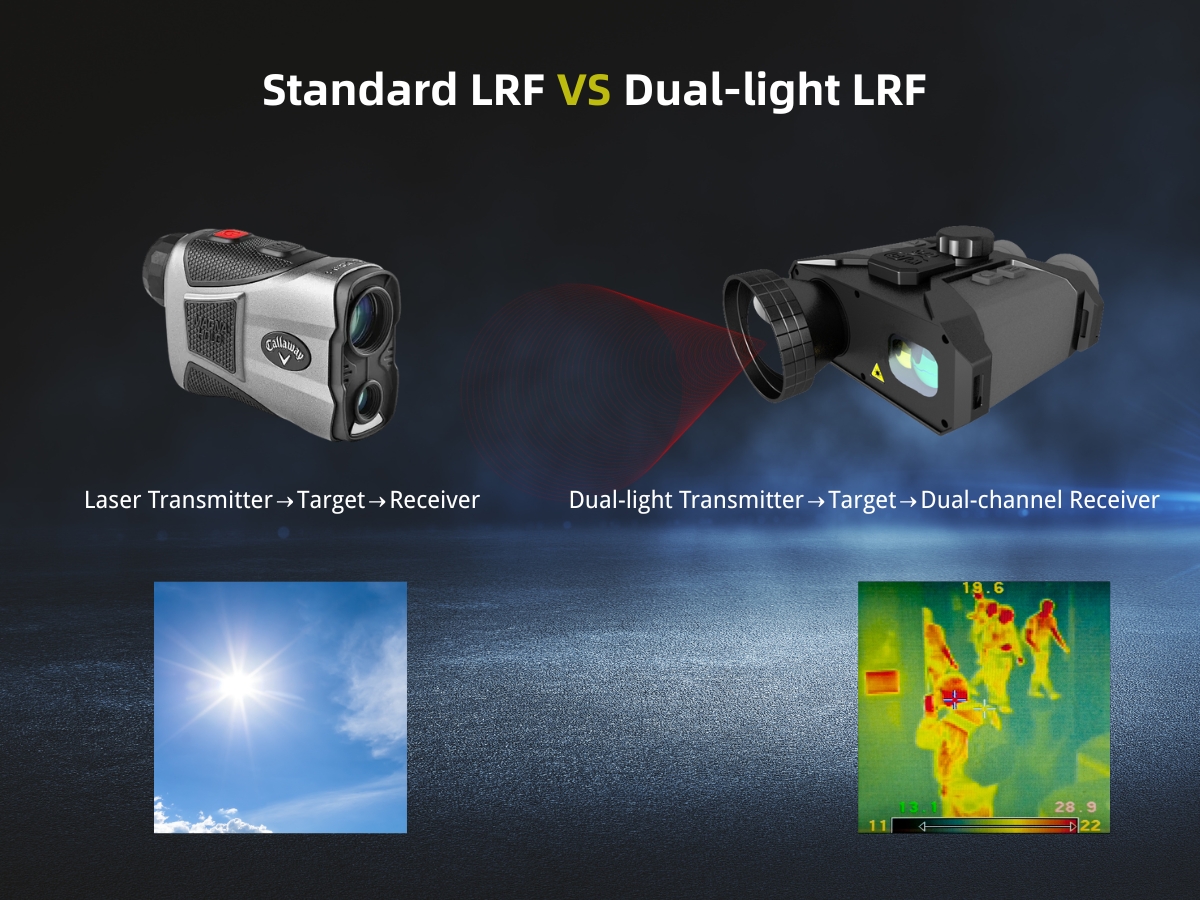

For professionals in surveying, defense, or search-and-rescue operations, choosing between traditional laser rangefinders and thermal-equipped devices can mean the difference between mission success and critical failure. This definitive guide examines how thermal imaging transforms ordinary distance measurement, with real-world data proving why dual-spectrum devices dominate high-stakes scenarios.
The Core Technology Divide
Traditional Laser Rangefinders
- Operate solely in the visible light spectrum (typically 905nm or 1550nm lasers)
- Require direct line-of-sight and adequate lighting
- Limited by common obstructions: fog, smoke, foliage
- Output: Distance measurement only
Thermal-Enabled Laser Rangefinders
- Combine visible laser with infrared camera technology (8-14μm spectrum)
- See heat signatures rather than relying on light reflection
- Penetrate visual obstructions through thermal differential
- Output: Distance + thermal imagery + GPS tagging
Performance Showdown: When Thermal Makes All the Difference
| Application Scenario | Single-Spectrum Performance | Thermal-Enabled Advantage |
|---|---|---|
|
Night Operations |
Requires visibility lights; limited to moonlit conditions |
Full darkness capability; detects human heat signatures at 2.8km |
|
Low-Visibility Environments |
Thermal penetration maintains >80% effectiveness |
Low-Visibility Environments |
|
Camouflaged Targets |
Cannot distinguish targets from background |
Thermal contrast reveals hidden objects (50mK sensitivity) |
|
Dynamic Measurement |
Single-point measurements only |
Continuous tracking with video recording |
Sakereye640-4: Thermal-Enabled Rangefinder Technical Dominance
Integrating professional-grade thermal imaging into a laser measuring tool creates unprecedented capabilities. The Sakereye640-4 exemplifies this evolution:
| Feature | Specification |
|---|---|
|
Laser Rangefinder |
1535nm · 10m-4km range · ±1m acc |
|
Thermal Camera |
640×512 detector · <50mK sens |
|
Detection Range |
Human: 2.8km · Vehicle: 7.0km |
|
Environmental Spec |
IP66 · -30°C to 60°C · 30g impact |
|
Power & Data |
6hr continuous · 16GB recording |
Transformative Capabilities
- Dual-Sensor Verification
Identify targets via thermal signature FIRST, then verify with laser measurement – eliminating false positives.
- Search Pattern Efficiency
Scan wide areas with 5.9°×4.7° thermal FOV while tagging distances to multiple targets.
- Evidence Collection
Record MPEG4 video with overlaid distance data for legal documentation.
Situations Where Thermal Wins
- Firefighting Operations
Thermal penetrates smoke to locate victims while rangefinder calculates rescue paths.
- Border Security
Detect illegal crossings at night without revealing position with visible lights.
- Infrastructure Inspection
Spot overheating components AND measure safe approach distance simultaneously.
- Wildlife Research
Track nocturnal animals without disruptive lighting.
- Tactical Military Ops
Recognize hostile heat signatures through camouflage netting.

Cost-Benefit Analysis
| Factor | Traditional Rangefinder | Thermal-Enabled Model |
|---|---|---|
|
Initial Investment |
US$300−1,500 |
US$2,000−6,000 |
|
Multifunctionality |
Single-purpose |
Replaces 3+ devices |
|
Daylight/clear conditions only |
Daylight/clear conditions only |
24/7 capability |
|
ROI Timeline |
Immediate |
6-18 months in professional use |
FAQ: Answering Critical Decision Questions
Q: Can thermal imagery actually improve measurement accuracy?
A: Absolutely. By positively identifying targets BEFORE ranging (e.g., distinguishing humans from rocks at 1km), you eliminate measurement errors from false targets. Thermal provides context that raw distance data cannot.
Q: Do thermal rangefinders require special training?
A: Basic operation is similar to traditional laser measurers. However, thermal interpretation proficiency can be achieved in under 4 hours with Sakereye640-4’s three imaging modes (thermal, visible, fused display).
Q: How does weather affect thermal rangefinder performance?
A: While heavy rain can slightly reduce thermal range, performance degradation is far less than visible-light devices. At -20°C, thermal contrast actually improves compared to summer conditions.
Q: Can I use thermal for daytime applications?
A: Yes. Thermal excels in daytime for spotting overheating machinery, hidden persons in shadows, or wildlife in dense vegetation where visible light fails.
Q: What’s the real battery cost of thermal?
A: Advanced models like Sakereye640-4 achieve 6+ hours on a single charge – sufficient for most operations. Swappable batteries extend this indefinitely.
The Strategic Conclusion
Traditional laser rangefinders remain excellent tools for golf, construction, and daylight surveying. But when operations demand:
- 24/7 capability regardless of lighting
- Penetration of visual obstructions
- Positive target identification
- Documentary evidence collection
Thermal-enabled devices become mission-critical investments. The Sakereye640-4 represents the new professional benchmark – combining military-grade thermal specifications with precision laser measurement for scenarios where failure isn’t an option.
 English