



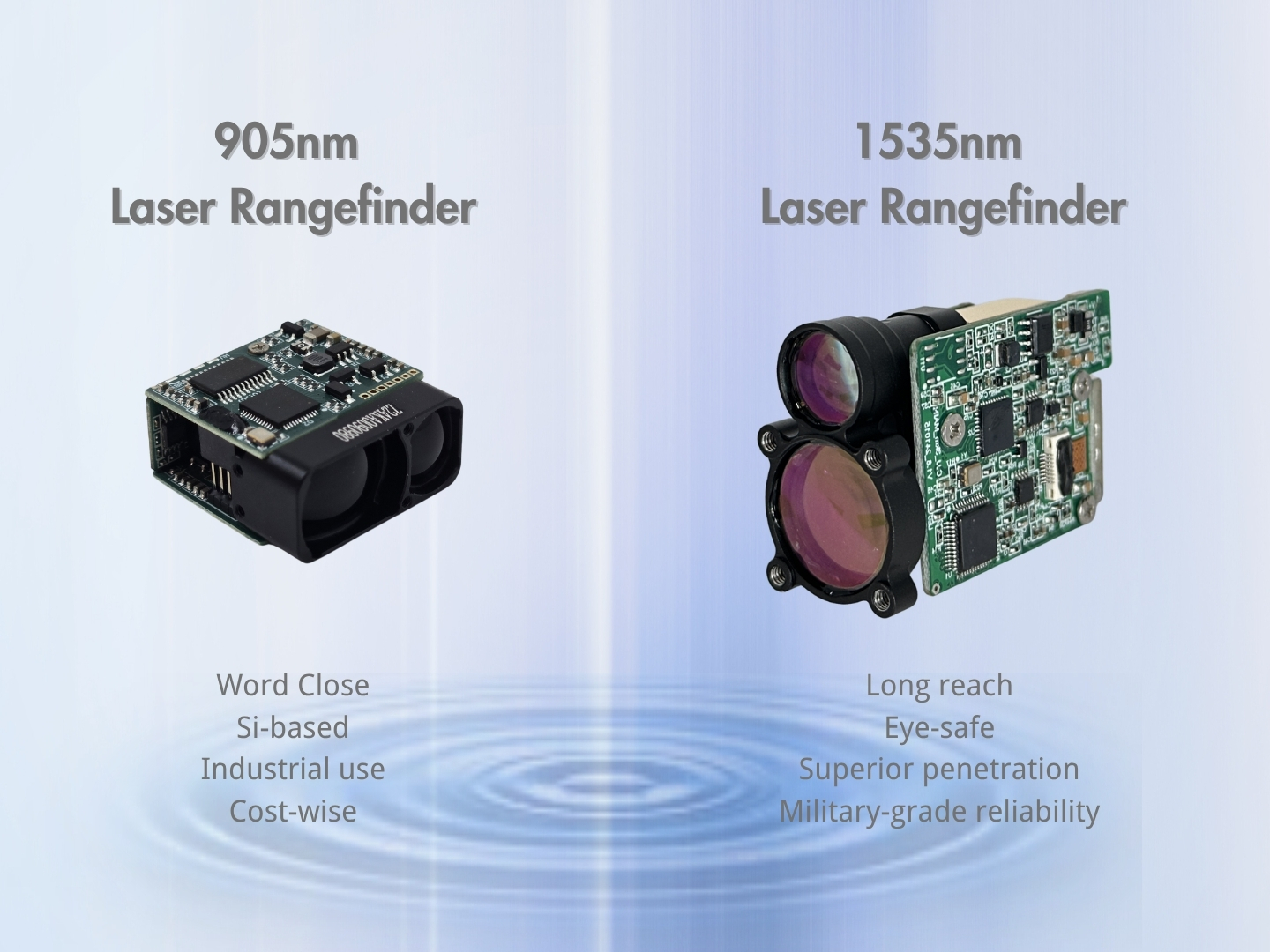

If you’re in the market for a laser rangefinder, whether for surveying, autonomous vehicles, or industrial automation, you’ve likely encountered a critical specification: the laser wavelength. Two of the common options are 905 nanometers (nm) and 1535 nanometers (nm). While they both perform the core function of distance measurement, the choice between them has significant implications for performance, safety, and cost.
This guide will break down the key differences between 1535nm and 905nm lidar systems to help you make an informed decision.
The Core Differentiator: It’s All About Eye Safety
The most crucial difference between these two laser wavelengths is their impact on human eye safety. This factor influences everything from the device’s power to its maximum range.
The 905nm Laser: Light at 905nm is very close to the visible spectrum. The human cornea and lens are transparent to this wavelength, allowing the laser beam to focus tightly onto the retina. This concentration of energy can cause permanent retinal damage. Consequently, safety regulations strictly limit the output power of 905nm laser diodes, which inherently caps their effective range.
The 1535nm Laser: This longer wavelength is classified as “eye-safe.” The front of the eye (the cornea and lens) absorbs and scatters 1535nm light, preventing it from ever focusing on the retina. This fundamental difference in laser safety means 1535nm rangefinder sensors can operate at much higher power levels without the same risk of injury, enabling them to achieve greater distances.
Performance Under Pressure: Atmospheric Penetration
A key factor in long-range laser measurement is how well the beam travels through the atmosphere. Both are affected by airborne particles and moisture, but to different degrees.
905nm Performance: This wavelength offers good performance in clear, dry conditions. However, it is more susceptible to scattering and absorption by fog, rain, and haze, which can significantly reduce its effective measurement distance in adverse weather.
1535nm Performance: The 1535nm wavelength lies within a favorable “atmospheric window,” meaning it experiences less absorption by water vapor. This superior atmospheric penetration makes 1535nm lidar technology more reliable and consistent in challenging environmental conditions, such as mist, light rain, or industrial smoke.
Technology, Cost, and Real-World Applications
The underlying technology and cost structure of these two options dictate their ideal use cases.
905nm Laser Rangefinders: The Cost-Effective Workhorse
Technology: This is a mature technology. The detectors are based on low-cost silicon (Si) sensors, specifically Silicon Avalanche Photodiodes (Si-APDs), making the system very affordable to manufacture.
Applications: The low cost per unit makes 905nm the dominant wavelength for high-volume applications like automotive lidar for consumer vehicles, consumer-grade golf and hunting rangefinders, and short-range industrial sensing.
1535nm Laser Rangefinders: The High-Performance Specialist
Technology: These systems require detectors made from Indium Gallium Arsenide (InGaAs), which are more complex and expensive to produce than silicon-based sensors. This results in a higher system cost.
Applications: The combination of long-range capability and inherent eye safety makes 1535nm the go-to choice for demanding applications. This includes military rangefinders (for tanks and artillery), high-end topographic lidar (airborne land mapping), and critical industrial safety systems where human exposure is a concern.
905nm vs. 1535nm: Quick Comparison Table
| Feature | 905nm Laser Rangefinder | 1535nm Laser Rangefinder |
|---|---|---|
|
Eye safety |
Lower |
High (Eye-Safe) |
|
Weather Penetration |
Good (in clear air) |
Excellent |
|
Maximum Range |
Medium |
Long |
|
Detector Technology |
Silicon (Si-APD) |
Indium Gallium Arsenide (InGaAs) |
|
Relative Cost |
Low |
High |
|
Best For |
Cost-sensitive, high-volume applications like automotive and consumer products. |
Safety-critical, long-range applications like military and topographic surveying. |
Conclusion: Which Wavelength is Right for Your Project?
The choice between a 905nm and a 1535nm laser rangefinder is not about which is universally “better,” but which is better for your specific needs.
Choose a 905nm laser rangefinder if your project is cost-sensitive, operates primarily in good conditions, and requires medium-range distance measurement. It is the ideal solution for the mass market.
Choose a 1535nm laser rangefinder if human eye safety is non-negotiable, you require long-range detection, and performance must be reliable in adverse weather. It is the premium choice for critical, high-performance applications.
Understanding this fundamental difference in lidar technology ensures you select a system that delivers the right balance of performance, safety, and value for your laser measurement and ranging requirements.
Frequently Asked Questions (FAQ)
Q: What is the main advantage of a 1535nm lidar system?
A: Its primary advantage is its inherent eye safety, which allows for higher power output and, consequently, longer range.
Q: Why is 905nm so common in car lidar?
A: Cost is the driving factor. For automotive manufacturers, the low cost of silicon-based 905nm sensors is essential for mass production.
Q: Can 1535nm lasers see through walls?
A: No. Neither 905nm nor 1535nm lasers can penetrate solid objects like walls. They are for measuring line-of-sight distance.

 English