

Introduction
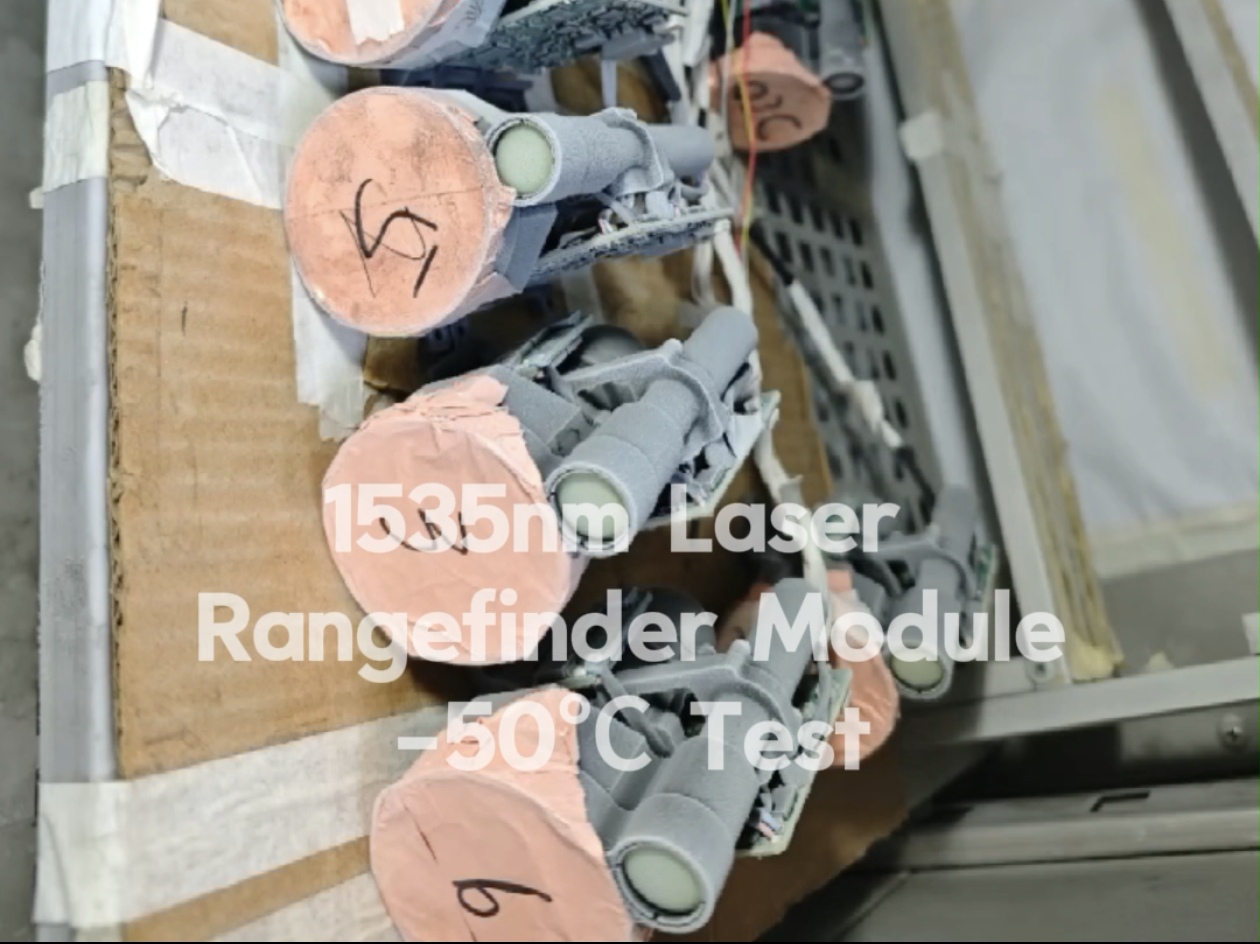
Demand is growing for robust laser rangefinders capable of operating in the world’s harshest environments. A critical challenge for any laser measuring tool is maintaining performance in extreme cold, where component failure and battery drain are common risks. In a recent rigorous low-temperature environmental test, Sunflaser’s 1535nm Laser Rangefinder Module was subjected to a punishing -50°C. The results confirm exceptional operational stability, paving the way for its use in polar research, high-altitude drones, and aerospace applications.
Conquering Extreme Cold for Unwavering Accuracy
This test was designed to push the module beyond its standard operating limits, evaluating its startup behavior, measurement stability, and overall reliability under deep freeze conditions. For a precise range finder, consistent accuracy is paramount, and temperature extremes can severely impact the electronics and laser source. Impressively, the Sunflaser module consistently powered on and delivered stable, accurate distance measurement readings throughout the testing cycle at -50°C. This resilience underscores a design built with high-reliability components, ensuring this laser measuring tool is a dependable solution for critical systems where failure is not an option.
Technical Advantages of the 1535nm Eye-Safe Laser
A key benefit of this module is its 1535nm wavelength, which qualifies it as an eye-safe laser rangefinder. This safety feature is crucial for applications where user protection is a priority, allowing for higher power outputs for better performance in adverse conditions like fog or snow without the significant risks associated with common 905nm lasers.
Key Product Specifications & Advantages
| Parameter | Specification | Advantage |
|---|---|---|
|
Wavelength |
1535 nm |
Eye-safe operation, enhanced performance in poor visibility. |
|
Ranging Accuracy |
≤±1m |
High precision for reliable data collection. |
|
Tested Temperature |
-50°C (beyond standard rating) |
Proven reliability in extreme cold, ensuring system integrity. |
|
Standard Operating Range |
-40°C to +70°C |
Suitable for a vast array of challenging environments. |
Conclusion
The successful -50°C environmental test validates the ruggedness and advanced engineering of Sunflaser’s 1535nm laser rangefinder module. It moves beyond being a simple laser distance measurement component to a hardened solution for mission-critical applications that operate where others cannot. For engineers designing systems for harsh environments, this module offers proven performance and peace of mind.
FAQ: Frequently Asked Questions
Q1: Why is an eye-safe laser important for a rangefinder?
A: An eye-safe laser, like this 1535nm module, operates at a wavelength that is naturally absorbed by the eye’s surface, drastically reducing the risk of retinal damage. This makes it safer for use around people and is often a regulatory requirement for many applications.
Q2: What applications benefit from a laser rangefinder that works at -50°C?
A: This capability is vital for:
Autonomous Drones (UAVs) conducting surveying or inspection in Arctic or high-altitude regions.
Scientific Monitoring Equipment deployed in polar research stations.
Industrial Automation systems in freezing, unheated warehouses.
Q3: How does low temperature typically affect a laser rangefinder module?
A: Extreme cold can cause battery voltage to drop, electronic components to malfunction, and materials to contract, potentially misaligning sensitive optical components. Testing at -50°C proves the module’s resilience against these effects.
Q4: Where can I find detailed technical data for this module?
A: For complete datasheets and application notes, please contact Sunflaser directly through their official website.
 English
  العربية
  Français