
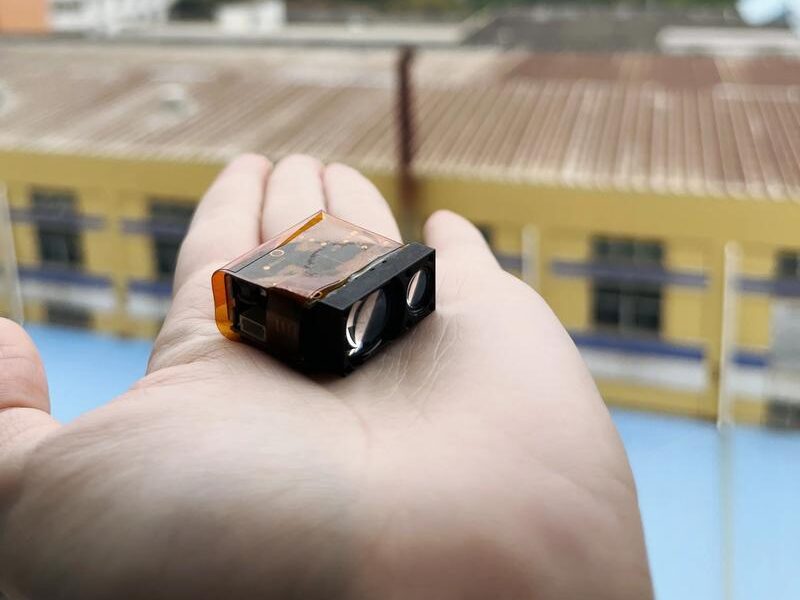

Laser rangefinder modules enable precision distance measurement across industries. The 905nm infrared laser module stands out for its safety, efficiency, and compactness. This article explains its working principles, technical advantages, and real-world applications—backed by verified data from industry-leading manufacturers.

How 905nm Laser Rangefinders Work: Time-of-Flight (ToF)
- Pulse Emission: Emits a 905nm infrared laser pulse (invisible to the human eye).
- Reflection Capture: The pulse bounces off the target and returns to the receiver.
- Time Calculation: Measures round-trip time (∆t) with nanosecond precision.
- Distance Output: Computes distance using: Distance = (Speed of Light × ∆t) / 2.
→ Frequency: Up to 5Hz (e.g., DA2501A module).
→ Accuracy: ±1m (within 300m) for high-reflectivity targets.
Why 905nm? 3 Technical Advantages
-
Eye-Safe & Efficient
- Complies with Class 1 Laser Safety (IEC 60825-1) – no protective gear needed.
- Low power consumption: ≤0.2W standby (SF-DYA1001A), ≤2W operating (DA2502B).
-
Atmospheric Penetration
- Minimal scattering in fog/dust vs. visible light.
- Range: Up to 3,000m under ≥10km visibility (DA3001A verified).
-
Compact & Robust
- Sizes as small as 26.5×14.2×16mm (SFA1200B, 13g).
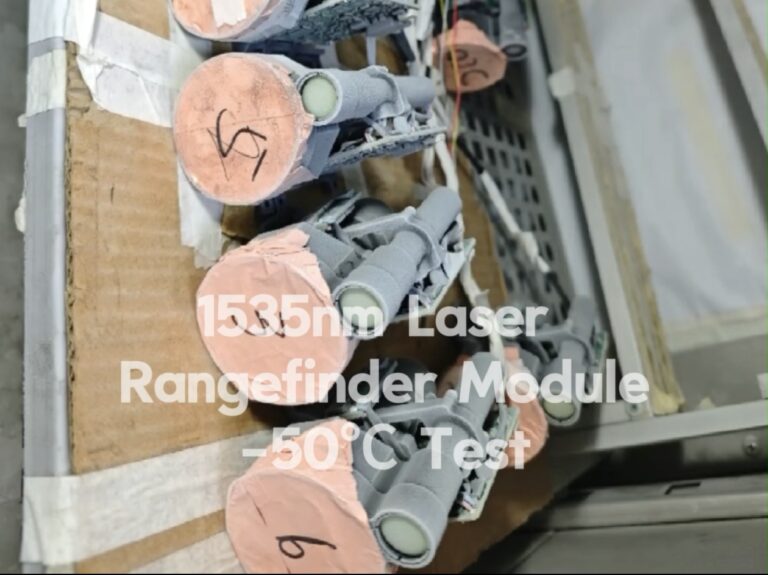
- Operating temp: -40°C to +60°C (DA2502B datasheet).
Critical Design Factors
✅ Optical Components
- Material: H-K9L optical glass (300–2100nm transmission).
- Coatings: 855–955nm AR coating → **≥99.5% light throughput** (DA1501A).
- Alignment: ≤2° deviation tolerance to prevent signal loss.
✅ Environmental Resilience
- Storage humidity: ≤70% RH (prevents lens fogging).
- Vibration resistance: Meets GJB 150.16A-2009 transport standards.
✅ Electrical Interface
- TTL/UART protocol (115,200 bps default).
- Simple commands: e.g.,
0x55 0x02 0xAA= single measurement trigger.
Top Applications
| Industry | Use Case | Recommended Module |
|---|---|---|
| Robotics | Obstacle avoidance | DA1503C (≤20g, 2Hz mode) |
| Industrial | Conveyor belt monitoring | DA1001A (1Hz/2Hz adaptive) |
| Security | Perimeter detection | DA2502B (-40°C operation) |
| Drones | Terrain mapping | SFA1200B (13g ultra-compact) |
⚠️ Note: Not recommended for water-surface measurement without calibration (per SFA2500B ).
FAQ: Key Questions Answered
Q1: Is 905nm laser safe for human eyes?
A: Yes. 905nm modules comply with Class 1 Laser Safety standards (IEC 60825-1), posing no eye hazard under normal use.
Q2: What affects measurement accuracy?
A: Primary factors:
- Target reflectivity (e.g., metal vs. foliage).
- Environmental conditions (fog/rain reduce range).
- Alignment precision (keep laser axis ±2° from perpendicular).
Q3: Can it measure through glass?
A: Not recommended. Glass may reflect >90% of 905nm light, triggering false short-distance readings.
Q4: What’s the typical module lifespan?
A: 10,000+ hours (with proper maintenance). Avoid:
- Temperature shocks (>10°C/min change).
- Direct sunlight exposure (>50°C).
Q5: How do I clean the optical window?
A: Use these steps:
- Blow dust with air bulb.
- Gently wipe with lens cloth + ether-alcohol mix (never touch with fingers).
Why Choose Industrial-Grade 905nm Modules?
- Tested Reliability: 98% hit probability at 1,500m (DYA-09C validation).
- Global Certifications: CE, RoHS, FCC compliant.
- Customization: Available for extreme temps (-40°C) or shock/vibration environments.
 English
  العربية
  Français
I’m interested in purchasing your 905nm rangefinder. I would need 11 of them. Do you have specs on them? Where do I buy them?
https://sunflaser.com/what-is-a-905nm-laser-rangefinder-module-core-principles-explained/
Thank you for your inquiry. We have replied to you by email. Please kindly check your inbox (and spam folder if necessary). We look forward to hearing from you.