
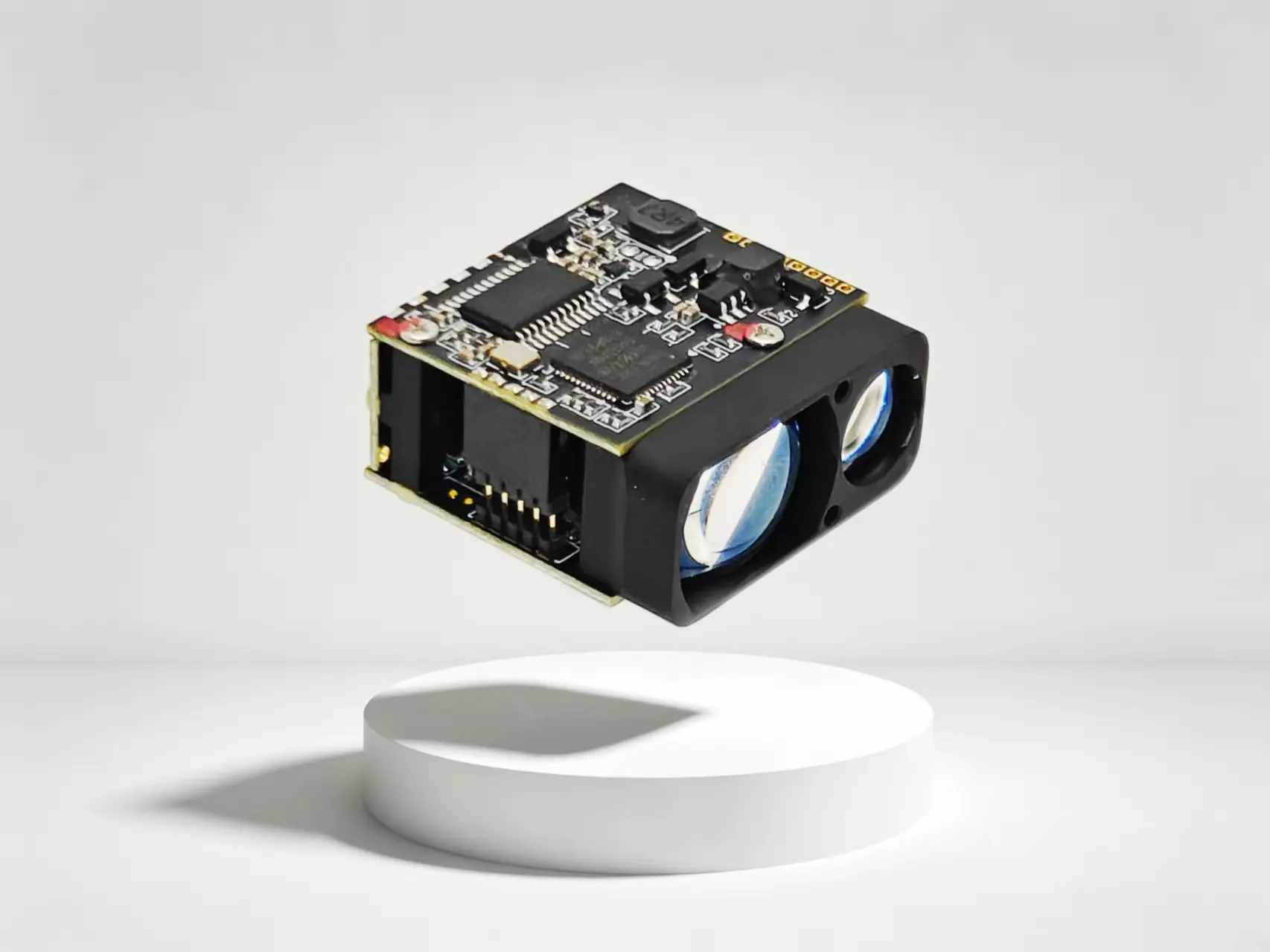

SunFlaser Technology (Chengdu) Launches the SFA2000A Micro Laser Ranging Module – 905nm TOF, 2000m Long Range
June 2026
To begin with, the SFA2000A adopts 905nm semiconductor laser and TOF (Time‑of‑Flight) ranging technology. As a result, it delivers stable full‑scale ranging from 2m to 2000m. Furthermore, it combines Class 1 eye safety, an ultra‑compact lightweight design, industrial‑grade reliability, and low power consumption for extended battery life. Consequently, it provides a professional solution for civil UAVs, outdoor observation, engineering surveying, security inspection, and other medium‑to‑long range high‑precision applications.
I. TOF Time‑of‑Flight: The Preferred Technology for Medium‑to‑Long Range Ranging
To begin with, the SFA2000A leverages the proven single‑pulse TOF laser ranging principle, integrated with a compact opto‑mechanical‑electronic design. As a result, it offers clear advantages over traditional ranging technologies in medium‑to‑long range measurement:
- First and foremost, it delivers 2000m long‑range detection capability – achieving up to 2000m on building targets at 60% reflectivity, and up to 1400m on vehicle targets at 30% reflectivity.
- Additionally, it provides high‑precision output across the full range – delivering accuracy of ±(0.4m + d×0.07%) for distances ≤800m, and stable ±1m accuracy for distances >800m.
- Moreover, it ensures Class 1 eye safety – complying with IEC 60825‑1 international standard, thereby making it safe for use in open environments.
- Furthermore, it features 1–5Hz adaptive measurement frequency – automatically optimising based on environment and target distance to balance precision and response speed.
- Finally, it achieves hit rate ≥98% and false‑alarm rate ≤1% – delivering more reliable measurements in complex environments.
II. Core Performance Specifications
To begin with, the SFA2000A achieves a ranging capability of 2000m (at 60% reflectivity, building target, visibility ≥6km), 1400m (at 30% reflectivity, 2.3×2.3m target), and 1000m (at 30% reflectivity, 0.5×1.7m target). Its minimum range is 2m. Furthermore, it delivers ranging accuracy of ±(0.4m + d×0.07%) for distances ≤800m, and ±1m for distances >800m. Additionally, it offers distance resolution of 0.1m.
In terms of physical design, the module features compact dimensions of 26mm × 25mm × 14mm (L × W × H) and weighs only 10.5 ± 0.5g – consequently, it is lighter than an ordinary USB flash drive. Its compact integrated design enables easy integration into various micro‑payload devices.
Regarding environmental adaptability, the module operates from ‑20°C to +70°C and stores from ‑25°C to +75°C. Furthermore, it withstands 1200g @ 1ms shock and 2.5g vibration, delivering industrial‑grade reliability with MTBF ≥1500 hours.
For power requirements, we design the module for DC 3–5V wide‑voltage compatibility. Standby power consumption is ≤0.5mW (Power on low) and ≤0.3W (Power on high). Operating power is ≤0.75W at 70°C and ≤0.6W at ‑20°C – consequently, this low power consumption extends battery life of portable devices.
Furthermore, the module supports single‑shot and continuous ranging mode switching, multiple baud rate configurations (115200/57600/38400/9600bps), adjustable laser brightness from 1% to 100% (for development use only), and real‑time full‑status self‑diagnostics. For communication, we equip it with a standard UART (TTL_3.3V) serial interface and provide a complete communication protocol and command set, enabling low‑threshold secondary development.
(Data based on standard conditions: line‑of‑sight, visibility ≥6km, relative humidity ≤60%. Smog, haze, or dusty weather may affect ranging performance. Lower target reflectivity or longer distances may reduce measurement frequency.)
III. Comprehensive Application Coverage
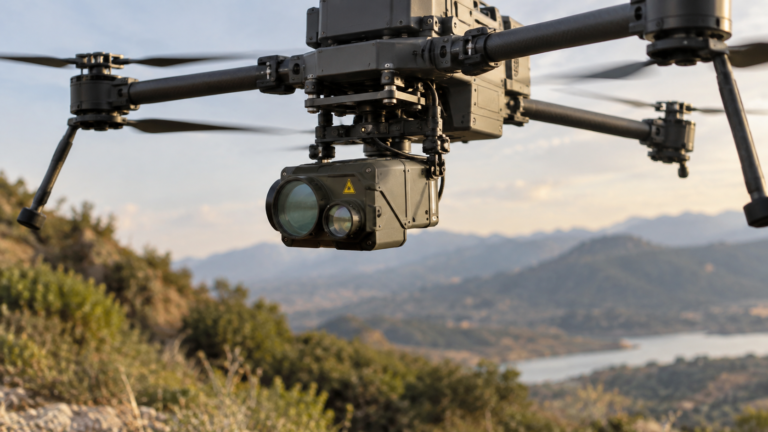
- Civil UAVs: To begin with, the module serves aerial surveying, power line inspection, forest fire monitoring, and border patrol. Its 10.5g lightweight design adds minimal payload, while its 2000m long‑range detection covers wide areas.
- Outdoor Observation: Secondly, it integrates into handheld rangefinders, telescope integration, and outdoor exploration gear – offering eye‑safe, portable, and easy‑to‑use operation.
- Engineering Surveying: Thirdly, it supports terrain mapping, construction surveying, and mine monitoring – delivering high precision, stable performance, and reliability in complex environments.
- Security Inspection: Fourthly, it facilitates perimeter security, factory surveillance, and pipeline inspection – leveraging 1–5Hz adaptive frequency and all‑weather operation.
- Industrial Automation: Additionally, it enables level measurement, object positioning, and production line inspection – featuring low power consumption, long battery life, and stable durability.
- Vehicle‑Mounted Optoelectronic Devices: Finally, it supports driver assistance, vehicle ranging, and road condition monitoring – with shock and vibration resistance, adapting well to vehicle environments.
IV. Usage Guidelines
Safety: To begin with, this product is a Class 1 eye‑safe laser. However, we advise avoiding direct viewing of the laser aperture to prevent potential eye strain. Furthermore, the spot calibration mode is for developer use only; laser brightness is adjustable in this mode – do not point the laser at human eyes.
ESD protection: Additionally, we require proper electrostatic discharge precautions. Do not touch any electronic components without appropriate protective measures. Never connect or disconnect cables while the module is powered on. Moreover, ensure correct power polarity; failure to do so may cause irreparable damage.
Window integration: Furthermore, if using an external window in system integration, we recommend that the window achieves a transmittance of ≥98% for the 905±20nm band. When installing, ensure the thread length of countersunk screws does not exceed 3.5mm. You may apply adhesive at the seams for additional fixation.
Optical window care: Additionally, keep the optical lens clean. Use a blower to remove dust particles. For fingerprints, gently wipe with a cotton swab dipped in a small amount of alcohol‑ether mixture, then clean with a lens cloth. Do not touch the optical surface directly with fingers.
Environmental precautions: Furthermore, avoid prolonged use in high‑temperature, humid, rainy, snowy, or dusty environments. Protect the module from rapid temperature changes or strong mechanical shocks.
Modification & cabling: Moreover, do not disassemble, modify, or alter the module, as this will void the warranty. Use the supplied communication cable. If using a custom cable, confirm correct pin assignments to prevent TX/RX reversal, which may cause communication errors.
Startup & communication: Finally, allow ≤200ms after power‑on for system initialisation. Pull the POWER_ON pin high before sending commands. The default baud rate is 115200bps, which you can configure to other rates via commands.
Closing Remarks
In conclusion, the SFA2000A combines TOF technology, 2000m long‑range capability, 10.5g ultra‑lightweight design, and industrial‑grade wide‑temperature reliability. Therefore, it serves as an ideal high‑performance ranging component for a wide range of medium‑to‑long range measurement and embedded integration needs. From UAVs and surveying to security and inspection applications, the SFA2000A empowers smart sensing to reach farther, become lighter, and deliver greater reliability.

 English
  العربية
  Français