
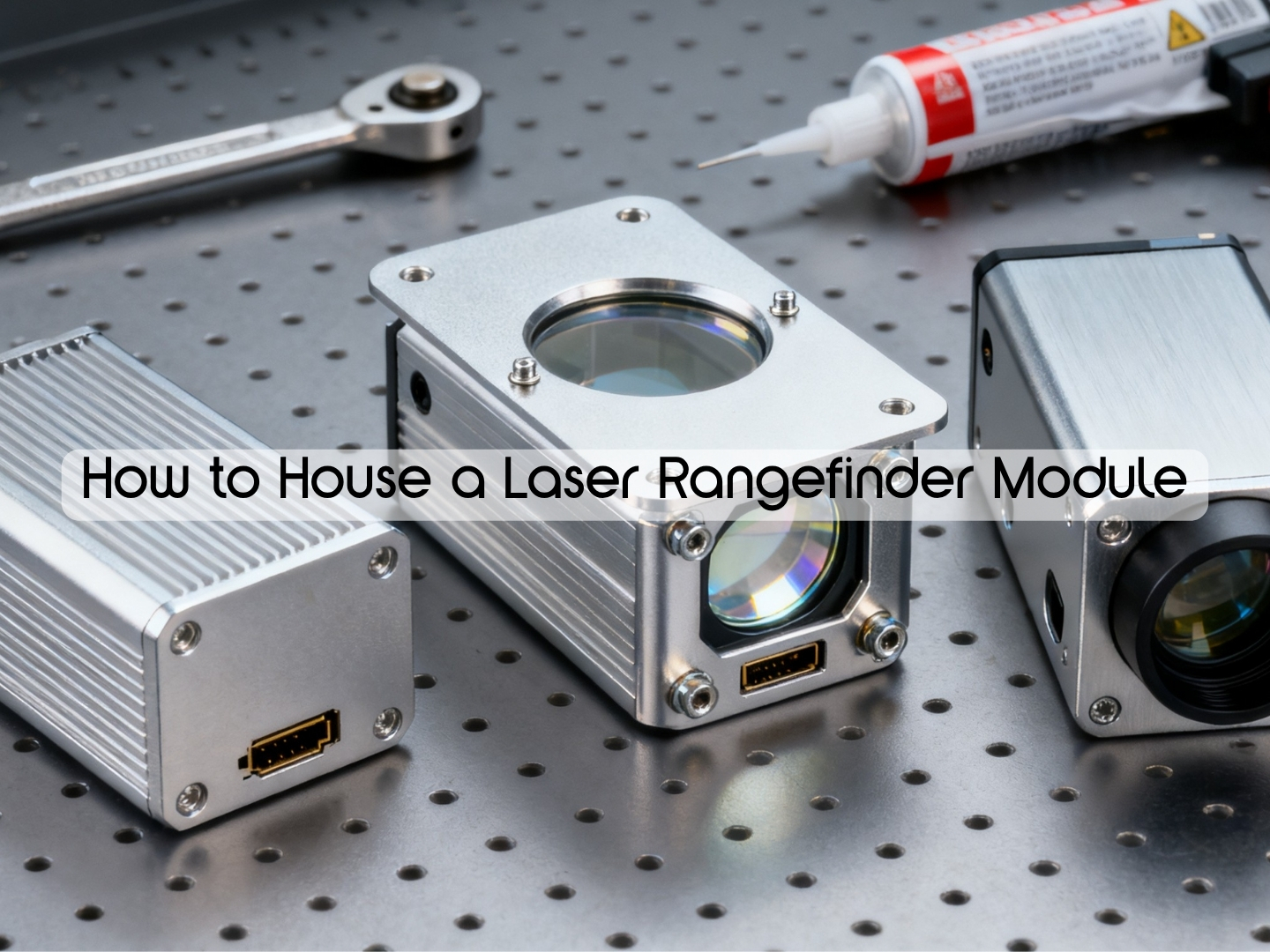

If you work with laser rangefinder modules—whether for defense, UAV navigation, industrial automation, or environmental monitoring—you know their precision relies on protecting sensitive components from harsh conditions. Adding a well-designed enclosure isn’t just about physical protection; it’s about preserving the module’s accuracy, extending its lifespan, and ensuring compliance with military or industrial standards like GJB150A-2009. In this guide, we’ll break down everything you need to know to install an enclosure for your high-precision laser rangefinder module, from material selection to testing.
Why Enclose Your Laser Rangefinder Module?
Before diving into the “how,” let’s clarify the “why.” A quality enclosure solves three critical challenges for laser distance measuring modules:
- Environmental Protection: Shields against dust, moisture, and extreme temperatures (Sunflaser modules typically operate from -40℃ to +60℃).
- Mechanical Stability: Reduces vibration/shock impact.
- Optical Integrity: Prevents damage to laser transmit/receive apertures while maintaining beam divergence angles.
Without a proper enclosure, even top-tier modules like the 1535nm DPSS laser rangefinder module risk performance drift or failure in field conditions.
Step 1: Prep Work – Gather Critical Module Specs
Before designing or selecting an enclosure, you must pull key parameters from your laser rangefinder’s datasheet. For Sunflaser modules, this data is readily available in the Product Brochure—here’s what to prioritize:
| Parameter Category | What to Confirm |
|---|---|
|
Dimension |
Length/width/height (including protruding ports), transmit/receive aperture size/spacing |
|
Optical |
Laser wavelength (905nm/1535nm), beam divergence angle |
|
Power |
Average/peak power consumption |
|
Environmental
|
IP rating, operating temperature range |
Pro Tip: For drone-mounted laser rangefinders, add weight to your list—enclosures should keep the total payload under your UAV’s limit.
Step 2: Choose the Right Enclosure Material
The material you pick will make or break your enclosure’s performance. Below’s a breakdown of top options, tailored to Sunflaser’s laser rangefinder module lineup:
Material Comparison for Laser Rangefinder Enclosures
| Material | Best For | Key Benefit | Laser Rangefinder Module Model Match (recommend) |
|---|---|---|---|
|
Aluminum Alloy 6061 |
High-power modules (≥1W), military/tactical use, general-purpose rugged scenarios |
Excellent thermal conductivity (155W/(m·K)), lightweight (2.7g/cm³), anodizable for corrosion resistance, complies with GJB150A-2009 |
1535nm Lrf: SFB3000A, SFB3000R, SFB3200A, SFB4000A, SF4000R, SFB5300A, SFB6000L, SFB6000R, SFB7300A, SFB8000R, SFB9500A, SFB10500A, SFB17500A, SFB20000R, SFB20000A |
|
Stainless Steel 304 |
High-humidity/seaside environments, corrosive industrial settings |
Extreme corrosion resistance (salt spray – resistant), high impact strength, maintains structural integrity at -40℃~+80℃ |
905nm Lrf: SFA1500A, SFA1500C, SFA2000B, SFA2000C; 1535nm Drone Target Detection series: SFB1500AW, SFB2000AW, SFB3000AW |
|
PC/ABS Alloy |
Low-power modules (≤1W), indoor/light outdoor use, cost-sensitive projects |
Lightweight (1.18–1.2g/cm³), good insulation, easy to injection-mold, low cost |
905nm Lrf: SFA200AH, SFA600A, SFA1000A, SFA1000B, SFA1000D; 1535nm Lrf: SFB3000A (light-load scenarios) |
|
Magnesium Alloy AZ31B |
UAV-mounted modules, portable handheld devices (weight-critical) |
Lighter than aluminum (1.8g/cm³), decent thermal conductivity (75W/(m·K)), high specific strength |
1535nm Drone Target Detection Lrf: SFB1500AW, SFB2000AW, SFB3000AW |
|
Carbon Fiber Composite |
High-end drone platforms, tactical portable devices (strength+lightweight) |
Ultra-light (1.7g/cm³), high tensile strength (5x aluminum), low thermal expansion |
1535nm Lrf: SFB17500A, SFB20000A (drone-mounted variants); |
|
PPS+30% Glass Fiber |
High-temperature industrial environments (up to +120℃), chemical exposure |
Excellent high-temperature resistance (continuous use at +120℃), chemical resistance, dimensional stability |
905nm Lrf: SFA1000D (factory automation); 1535nm Lrf: SFB4000A (infrastructure monitoring) |
Key Material Selection Rules (Per Sunflaser Module Traits)
- For eye-safe 1535nm modules : Pair any enclosure material with a quartz glass optical window (transmittance ≥90%) to avoid infrared light absorption.
- For 905nm semiconductor modules : Avoid materials with high infrared reflectivity (e.g., uncoated aluminum) near the aperture—opt for black anodization to reduce stray light.
- For military-grade modules: Prioritize aluminum alloy 6061 or stainless steel 304 to meet GJB150A-2009 environmental and GJB151B-2013 EMC standards.
Step 3: Step-by-Step Enclosure Installation
Follow these steps to ensure your enclosure doesn’t compromise your laser rangefinder’s accuracy:
1. Design the Enclosure (or Source a Custom One)
- Optical Window: Align with the module’s transmit/receive apertures (center deviation ≤0.1mm). The window should extend ≥2mm beyond the aperture to avoid blocking the laser path. Use quartz glass for 905nm/1535nm modules—ordinary glass will absorb infrared light.
- Heat Dissipation: For high-power modules (like the SFB20000A), add heat fins (1.5mm thick, 5mm spacing) or a thermal pad (0.5mm silicone) to the enclosure’s inner wall. For magnesium alloy enclosures, supplement with thermal grease at the module’s heat-generating points (laser driver ICs).
- Interface Openings: Cut holes for power (TTL/RS422) and communication ports—size holes 0.2–0.5mm larger than the connector (e.g., J30J-9ZKP for RS422 in SFB3000AW) to avoid cable strain. For carbon fiber enclosures, use metal inserts for interface holes to prevent cracking.
2. Prep the Module & Enclosure
- Clean both the module surface and enclosure inner wall with isopropyl alcohol to remove dust/oil.
- Attach 1–2mm EVA foam to the enclosure’s inner edges—this buffers vibration (critical for tactical laser rangefinders used in artillery or border security).
3. Align & Secure the Module
- Place the module in the enclosure, double-checking that the optical apertures line up with the window. Verify alignment with a red light pen: shine it through the window—if the module’s receive end (e.g., SFA1000D’s receiver aperture) detects the light, you’re good to go.
- Secure the module: Use 3M VHB tape for small modules (≤20g, e.g., SFA1000B) or M2–M3 screws (torque 0.5–1N·m) for larger units (≥50g, e.g., SFB3000A). For carbon fiber enclosures, use self-tapping screws with washers to distribute pressure.
4. Seal & Ground (If Metal)
- Seal gaps with waterproof glue (Dow Corning 734 silicone) to maintain IP67 protection—pay extra attention to the optical window and interface holes (critical for lrf used in rainy outdoor settings).
- For metal enclosures (aluminum, stainless steel, magnesium), add a grounding stud to avoid electromagnetic interference (EMI)—critical for complying with GJB151B-2013 (military EMC standards) for modules like SFB20000A.
Step 4: Test & Validate the Enclosed Module
Even the best installation needs testing to ensure it doesn’t harm your laser rangefinder’s performance. Use these tests, aligned with Sunflaser’s military-grade standards (per the Product Brochure-Sunflaser Tech202511.pdf):
1. Optical Performance Test:
- Measure maximum ranging distance (under 10km visibility, ≤60% humidity). For example, the SFB20000A should still reach ≥19km (≤5% deviation from pre-installation); the SFA1000D should maintain ≥950m.
- Check accuracy: Test at 100m, 1km, and max range—error should stay within ±1–2m (e.g., SFB4000A: ±1m; SFA200AH: ≤±0.1m at >10m).
2. Heat Dissipation Test:
- Run the module at full load for 2 hours (25℃ room temp). Use an infrared thermometer—surface temp should stay ≤55℃ for +60℃ rated modules (e.g., SFB3000A) and ≤65℃ for PPS-enclosed industrial modules (e.g., SFA1000D).
3. Environmental Test:
- Waterproof: Submerge the enclosed module in 1m water for 30 minutes—no internal water, and the module should function normally (critical for SFB1500AW used in marine drone monitoring).
- Vibration/Shock: Run 5–200–5Hz vibration (2.5g acceleration) and 30g/11ms shocks—no loose parts or accuracy drift (per SFA series shock standards).
FAQ: Common Questions About Sunflaser Laser Rangefinder Enclosures
Q1: Can I use carbon fiber enclosures for high-power modules like the SFB20000A?
A: No—carbon fiber has low thermal conductivity (10–100W/(m·K) depending on weave), which traps heat from high-power modules (8W peak for SFB20000A). Stick to aluminum alloy 6061 for these models to avoid overheating.
Q2: How do I match enclosure materials to Sunflaser’s drone-mounted modules (e.g., SFB2000AW)?
A: Prioritize weight and vibration resistance. Magnesium alloy AZ31B (1.8g/cm³) or carbon fiber (1.7g/cm³) are ideal—they keep the payload light while absorbing drone vibrations. Avoid stainless steel (7.9g/cm³) unless the module is used in coastal areas.
Q3: Do all Sunflaser laser rangefinder modules require IP67 enclosures?
A: Most do—per the brochure, models like SFA1000D, SFB3000AW, and SFD4000B have IP67 ratings. Use waterproof materials (e.g., aluminum with O-rings, PPS + glass fiber) and seal all gaps with silicone glue to maintain this protection.
Q4: Can I reuse enclosures across different Sunflaser module models?
A: Rarely—each model has unique dimensions (e.g., SFA1000D: Φ17×37.2mm vs. SFB2000A: 133×99×77mm) and aperture positions. Customize enclosures per model specs to avoid optical misalignment or interface blockages.

 English
  العربية
  Français